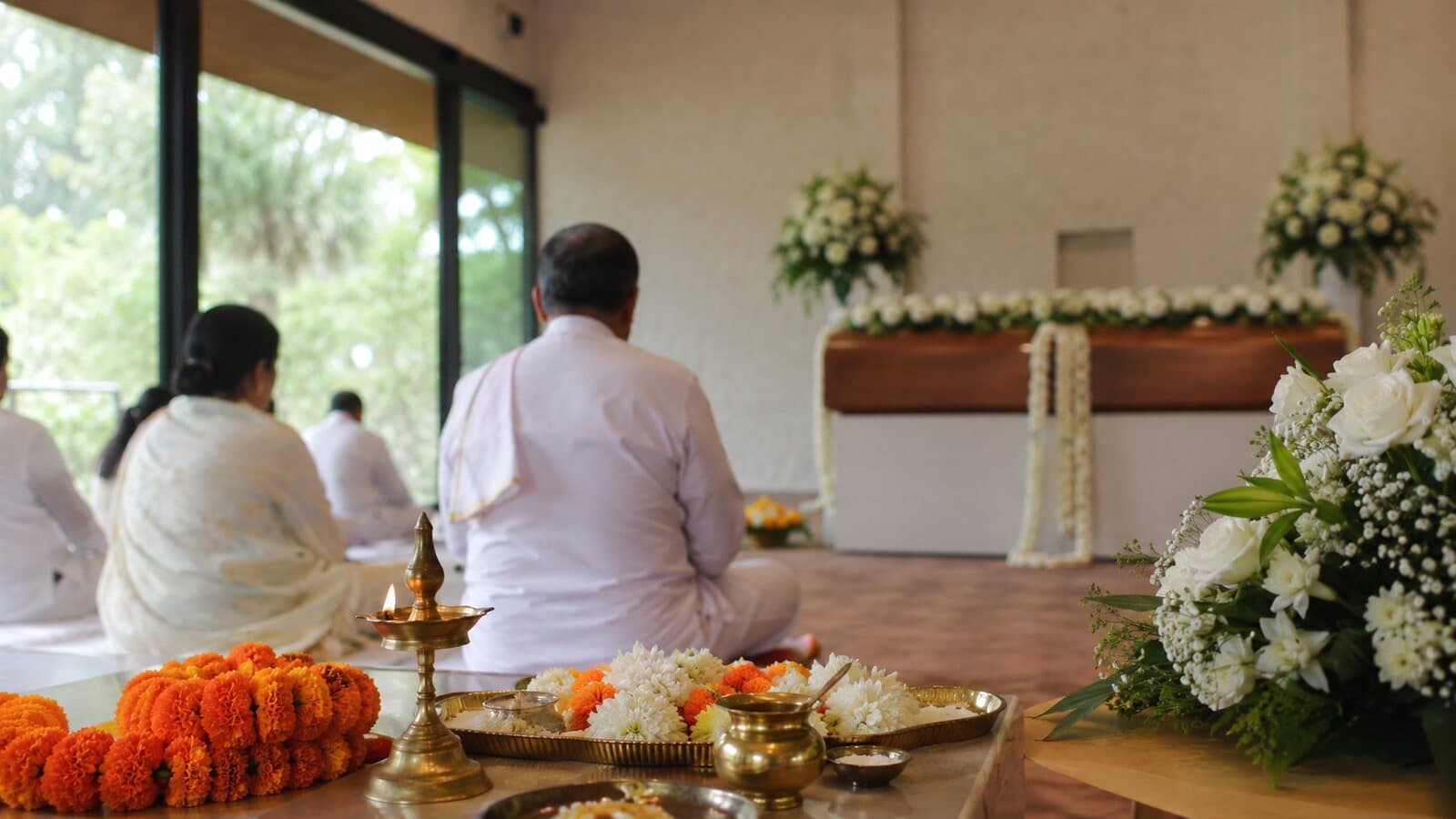
What happens at a Hindu funeral in Australia?
Hindu funerals centre on fire. Cremation is the strongly preferred rite in Hinduism for adults. The fire is understood to release the atman (soul) from the body, freeing it to continue its journey through the cycle of death and rebirth. There are recognised exceptions: very young children, sannyasis (renunciants) and some saints are traditionally buried rather than cremated.
The funeral rites are called antyesti, meaning "last sacrifice." They follow a sequence that begins at the moment of death and continues through 13 days of mourning, culminating in the immersion of ashes in flowing water.
Australia's Hindu community, numbering 684,000 at the 2021 Census, has adapted these ancient rites to local conditions. Open funeral pyres are not permitted under Australian law, so families have developed practical workarounds that preserve the spiritual meaning of the tradition while working within the Australian cremation system.
The Hindu Council of Australia is the national peak body for the Hindu community and can help connect families with local temple priests and community support.
Immediately after death
When a Hindu person dies, the family gathers around the body. A lamp or candle is lit near the head, and it remains burning until the cremation. In many Hindu traditions, the body is placed on the floor with the head facing south, the direction associated with Yama (the deity of death) in Hindu cosmology, though practice varies by regional tradition.
Family members wash the body with water and, in some traditions, a mixture of five substances called panchamrit: milk, yoghurt (curd), ghee (clarified butter), honey, and sugar. The body is dressed in simple, clean clothing. A white cloth is common. Flowers, particularly marigolds, are placed around the body. Tulsi (holy basil) leaves may be placed in the mouth.
Embalming is generally not practised and is discouraged in Hindu tradition. The tradition calls for cremation as soon as possible after death, often on the same day or the following day, and avoids artificial preservation of the body.
The eldest son's role
The eldest son (or, in his absence, the closest male relative) carries a specific set of responsibilities in Hindu funeral rites. He is called the karta (the one who performs the rites).
In India, the karta lights the funeral pyre. In Australia, where open pyres are not available, the karta's role has been adapted. The eldest son kindles a consecrated fire (agni) in a small terracotta pot at the family home, using clarified butter as fuel. This pot is carried to the crematorium and placed on top of the coffin as it enters the cremation chamber. The act of placing the fire on the coffin preserves the symbolic role of the eldest son lighting the cremation.
In India this rite is called mukhagni, the lighting of the pyre at the mouth. During traditional cremation the karta also performs kapala kriya, symbolically cracking the skull to release the soul. In Australian crematoria these acts are symbolic or set aside, and the consecrated fire pot stands in for the lighting of the pyre.
Women's participation in Hindu funerals has evolved. Traditionally, women observed the cremation from a distance and did not attend the crematorium. In contemporary Australian practice, women increasingly attend and participate, though some families still observe the older custom.
At the crematorium
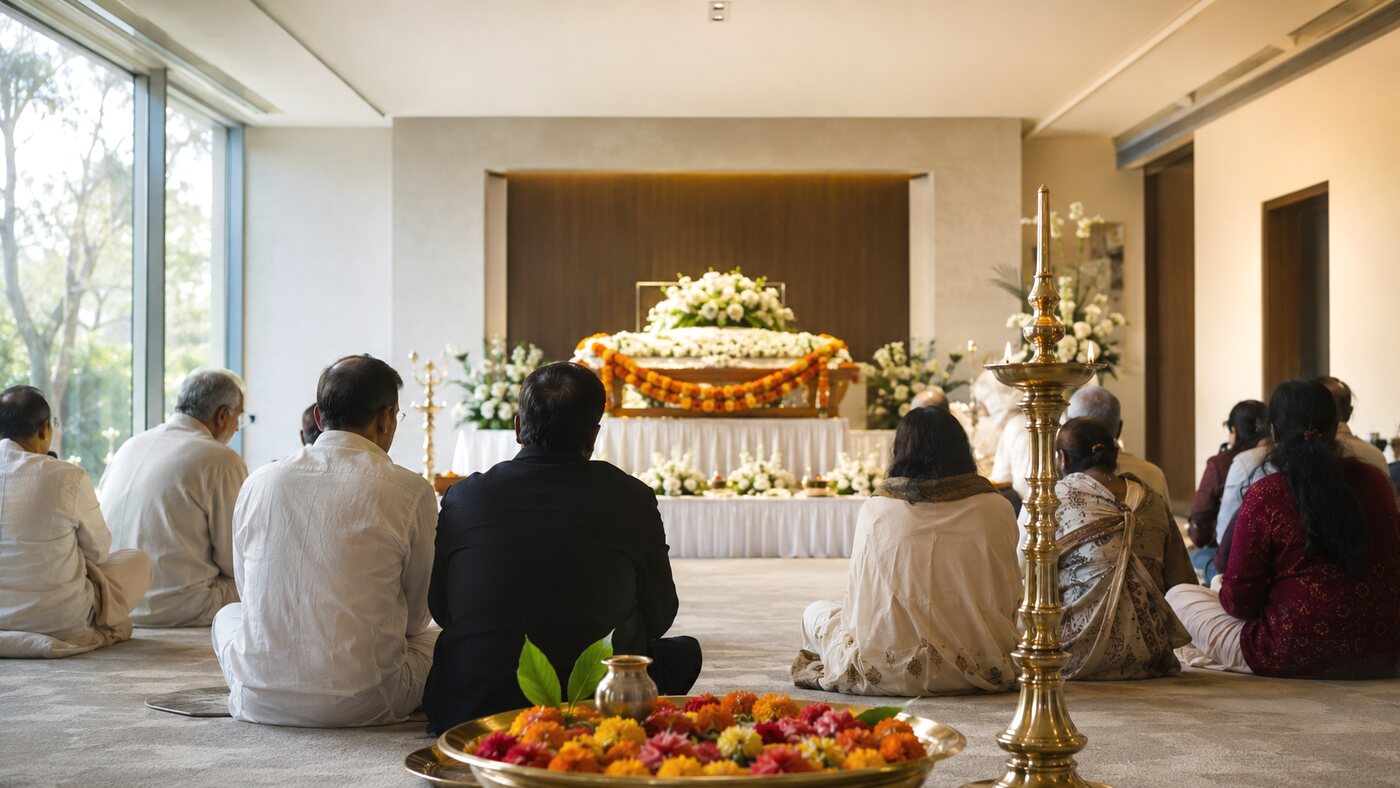
The body is taken to the crematorium in a coffin. At the crematorium, a Hindu priest (pandit) leads the rites. Mantras are chanted, including invocations to Agni (the fire deity) to carry the soul upward. The family circles the coffin, and prayers are offered for the peaceful transition of the soul.
The eldest son (or karta) performs the ritual acts: placing the fire pot on the coffin, offering rice and sesame seeds, and reciting prayers with the priest. The coffin then enters the cremation chamber.
The cremation itself takes place behind closed doors at Australian crematoria. Some crematoria allow a small group of family members to remain in an observation area during the initial stages of the cremation. Availability of this option varies by crematorium, and families often ask about it when making arrangements.
Ash collection and immersion
After cremation, the ashes and bone remains (asthi) are collected by the family. The immersion rite is called asthi visarjan. In India, ashes are immersed in the Ganges or another sacred river. In Australia, families have adapted this practice to local waterways.
Common sites for ash immersion in Australia include the Georges River in south-west Sydney, the Swan River in Perth, the Yarra River in Melbourne, and the ocean at various coastal locations. Scattering cremated ashes at sea is explicitly excluded from the definition of "sea dumping" under Commonwealth law, as confirmed by the Department of Climate Change, Energy, the Environment and Water, so no federal permit is required for ash scattering at sea. State regulations on ash dispersal in rivers vary, and families should confirm current requirements with their state health authority before scattering ashes in freshwater.
Some families choose to send a portion of the ashes to India for immersion in the Ganges. This involves packaging the ashes according to airline regulations and either travelling with them or sending them with a family member. The logistics are manageable, though the timing adds days or weeks to the completion of the rites.
The 13-day mourning period
The antyesti rites span 13 days. During this period, the immediate family observes mourning at home.
| Day | What happens |
|---|---|
| Days 1 to 9 | Family mourns at home in simple clothing, avoids temples and social events, eats simple vegetarian meals |
| Day 10 | Purification ceremony (dashakriya); the home is cleaned and some normal activity resumes |
| Day 13 | Ceremony marking the formal end of mourning, with prayers, offerings to ancestors, and a community meal |
The customs vary by region and community. White, not black, is the traditional colour of mourning, and daily prayers are performed at home, often led by a priest. Visitors come to the home to offer condolences, and the community typically brings food.
On the 13th day, a ceremony marks the formal end of mourning. In North Indian Hindu communities this day is called terahvin (from the Hindi for "thirteenth"); in other regional traditions it has different names. In the days before it, families may perform Sapindikarana, the rite that unites the deceased with the ancestors. The exact sequence and names vary significantly by region and community, so confirm with your priest. The priest leads prayers, offerings are made to the ancestors, and a meal is prepared for family, friends, and the community. The rite is both a farewell to the deceased and a reaffirmation of the family's connection to their ancestors.
Some communities extend mourning beyond 13 days, with additional observances at 40 days or on the first anniversary.
Regional and community variation
Hinduism is not a single, centralised religion. Funeral customs vary significantly by region of origin, caste, and family tradition. A Gujarati Hindu family's funeral may differ in specific details from a Tamil Hindu or Bengali Hindu funeral, even though the core elements (cremation, eldest son's role, ash immersion, 13-day mourning) remain consistent.
In Australia, this means there is no single "standard" Hindu funeral. Families usually talk through their specific traditions with the priest and the funeral director. Funeral directors experienced with Hindu funerals tend to be familiar with the common requirements (rapid cremation, no embalming, accommodation of the fire pot, family access at the crematorium) and can advise on what is possible at each facility.
What to expect if you are attending
Hindu funerals are open to non-Hindu guests. Dress conservatively in simple, muted colours. White is the traditional mourning colour in Hinduism, but wearing dark or neutral tones is also appropriate. Remove shoes if the service is held at a temple or the family home.
The atmosphere is solemn. Chanting and prayers are conducted in Sanskrit or Hindi, and guests are not expected to participate in the recitations. You may observe respectfully.
Flowers (particularly white or yellow flowers) are an appropriate offering. Some families request donations to a charity in lieu of flowers.
At the crematorium, the service typically lasts 30 to 60 minutes. Guests may be invited to circle the coffin with the family before the cremation.
During the 13-day mourning period, visiting the family home to offer condolences is welcomed. Bringing vegetarian food is appreciated.
Related information
- Same-day funeral logistics (Muslim, Jewish, Hindu)
- How much does a cremation cost in Australia?
- How much does a funeral cost in Australia?
- Find a Hindu funeral director
- Back to all guides
Further reading
- Antyesti - Wikipedia - Overview of Hindu funeral rites across regional traditions, with Vedic textual sources.
- Hindu Council of Australia - Peak national body for the Hindu community in Australia; contact point for families seeking guidance on local arrangements.
- Religious affiliation in Australia - ABS, 2021 - Census data on the size and growth of Australia's Hindu community.
- Shraddha - Wikipedia - Detailed explanation of ancestral offering rites, including the pinda offering and the annual Pitru Paksha observances.
- Sea dumping law - DCCEEW - Commonwealth guidance confirming that ash scattering at sea is not regulated as sea dumping.
Frequently asked questions
What happens at a Hindu funeral?
Does Hinduism require cremation?
How long is Hindu mourning?
Can ashes be scattered in Australian rivers?
What should I wear to a Hindu funeral?
This guide is general information to help Australian families, editorially reviewed by the Funerals Direct team from publicly available sources. It is not legal or financial advice. Funeral prices change and vary by provider and region, so always ask for an itemised written quote. For prepaid funerals, bonds, or insurance, consider speaking with an independent financial adviser or a free financial counsellor on 1800 007 007.
Ready to find a funeral director?
Compare directors who list the right experience, read reviews from other families, and request a quote. Always free for families.
Find a Hindu funeral directorWas this guide helpful?