What happens at a Greek Orthodox funeral in Australia?
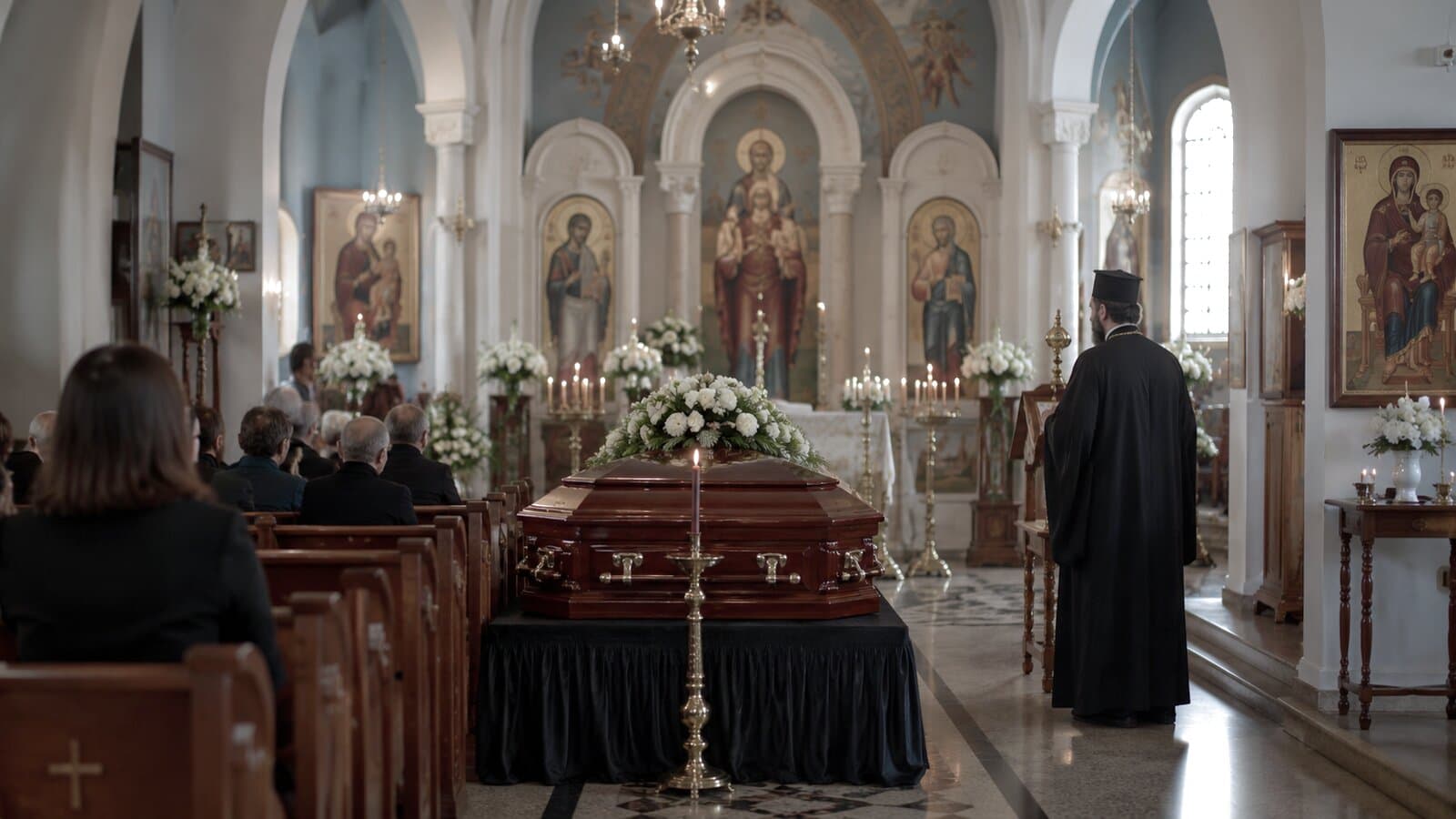
Few cities outside Greece have larger Greek-diaspora populations than Melbourne and Sydney. Greek Orthodox funerals follow a tradition that has changed very little over centuries. The rites are formal, deeply liturgical, and follow a sequence that begins at the moment of death and continues through memorial services held for years afterwards.
In Australia these rites are held under the Greek Orthodox Archdiocese of Australia, which oversees most Greek parishes across the country.
The rites move through a recognised sequence:
| Stage | What happens | Timing |
|---|---|---|
| Trisagion | Short prayer service, usually at the funeral home during a viewing | After death, may be served more than once |
| Funeral service | Body brought to the church, casket traditionally open, Byzantine chant, scripture and prayers | Funeral day |
| At the cemetery | Trisagion repeated, priest pours wine and oil over the coffin, burial facing east | After the church service |
| Makaria | Memorial meal hosted by the family at a hall, restaurant, or home | After the burial |
From death to burial
Greek Orthodox tradition expects burial to happen quickly, though not with the same-day urgency of Jewish or Muslim custom. The body is washed and dressed, and the family arranges for a funeral director. The priest is contacted immediately.
Between death and the funeral, the family gathers for prayer. Friends and relatives visit to pay respects, and the atmosphere is one of communal grief rather than private mourning.
The Trisagion (memorial prayer service)
The Trisagion is a short prayer service held after death, usually at the funeral home during a viewing. The name comes from the Greek for "thrice holy" (tris, thrice + agios, holy), referring to the repeated invocation "Holy God, Holy Mighty, Holy Immortal, have mercy on us."
The Trisagion may be served more than once between death and burial. It is the first formal liturgical act after death and sets the tone for what follows. The priest leads the prayers, and the family and close friends attend.
The funeral service
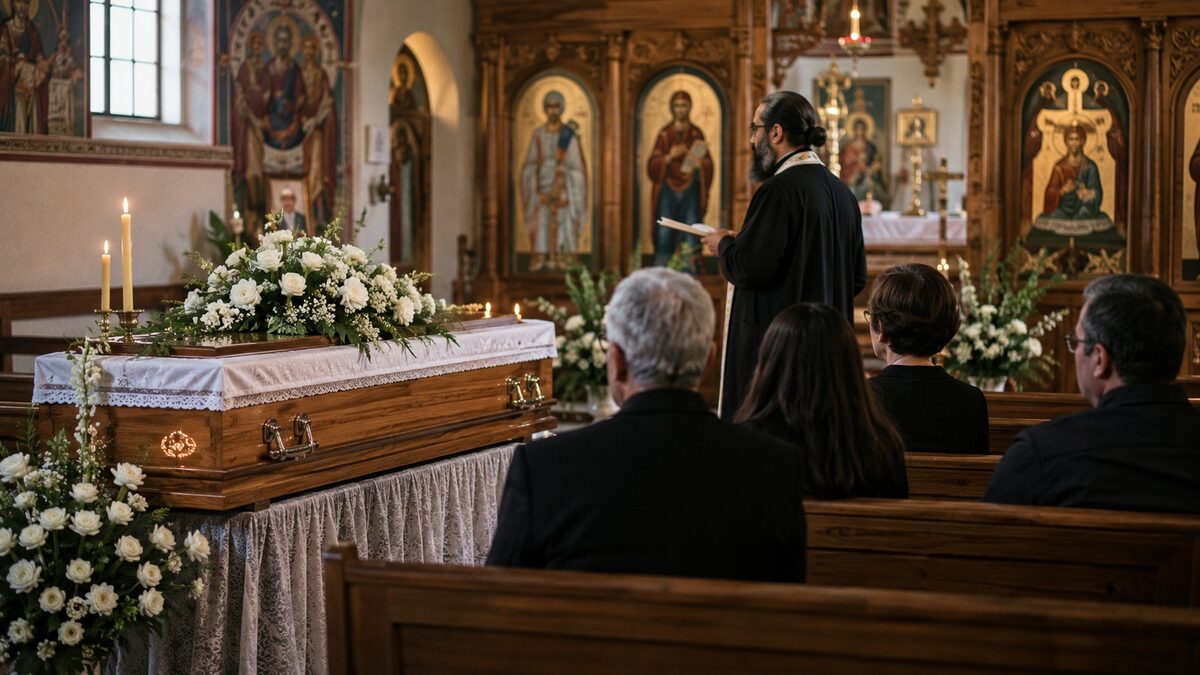
On the day of the funeral, the body is brought to the church for the funeral service. In ideal circumstances, the funeral service is accompanied by the Divine Liturgy (the Orthodox equivalent of a Catholic mass), though this is not always possible given scheduling and clergy availability.
Open casket. The casket is traditionally left open during the church service. An icon of Christ or the Theotokos (Mother of God) is placed on the body or inside the coffin. Mourners file past the open casket to pay their last respects, often kissing the icon or making the sign of the cross.
The open casket is a central element of the Greek Orthodox funeral. It reflects the theology that death is a physical reality to be faced rather than hidden. Families who find this difficult sometimes raise it with the priest, though closing the casket during the church service runs against usual Orthodox practice.
The service itself includes scripture readings, hymns sung by a cantor (psaltis), prayers for the repose of the soul, and the reading of the Apostle Paul's words on resurrection. The congregation stands for most of the service. There are no eulogies during the Orthodox funeral liturgy in the way that Anglican or Catholic services include them. The focus is entirely on prayer and scripture.
Music. Orthodox funerals use Byzantine chant sung by the cantor, not congregational hymns in the Western sense. Secular music, songs from other Christian traditions, and recorded music are not permitted during the service. The music is unaccompanied (no organ, no instruments). This is a consistent rule across all Orthodox parishes.
At the cemetery
After the church service, the procession moves to the cemetery. The Trisagion is repeated at the graveside. The priest pours a mixture of wine and oil over the lowered coffin, a rite symbolising the anointing of the body. Earth is sprinkled on the coffin, and mourners may each drop a handful of soil or a flower into the grave.
The body is buried facing east. This orientation symbolises where the sun rises and, in Orthodox theology, the direction from which Christ will return. The funeral director and cemetery usually coordinate the grave orientation.
The wake (makaria)
After the burial, the family hosts a memorial meal called the makaria. This is typically held at a hall, restaurant, or the family home. The meal includes fish (a symbol of Christ), bread, wine, and other traditional foods. The priest blesses the food and says a prayer before the meal begins.
The makaria is not a celebration of life in the secular sense. It is a communal gathering where the community supports the grieving family, and the tone is sombre.
The priest also blesses the home of the deceased after the funeral, praying for the family's comfort.
Koliva (memorial wheat)
Koliva (sometimes spelled kollyva) is one of the most distinctive elements of Greek Orthodox mourning. It is boiled wheat mixed with sugar, sesame seeds, pomegranate, almonds, and spices, formed into a mound and decorated with a cross made from powdered sugar or silver dragees.
The symbolism is drawn from John 12:24: as the wheat kernel falls to the earth and dies, it brings forth new life. Koliva stands for the hope of resurrection.
Koliva is prepared for the funeral and for every subsequent memorial service. The priest blesses it during the memorial, and portions are distributed to all who attend. Preparing koliva is often the responsibility of a specific family member or a member of the parish community, and the recipe and presentation vary by family tradition.
Memorial services (mnimosyno)
The Greek Orthodox Church prescribes a cycle of memorial services after death:
- 3rd day after death
- 9th day after death
- 40th day (the mnimosyno, the most significant memorial)
- 3 months, 6 months, 9 months, 12 months (Greek Orthodox custom)
- Yearly anniversaries thereafter
The 40-day memorial holds particular theological significance. Orthodox tradition holds that the soul undergoes a period of transition after death, and the 40th day is when the most solemn commemorative prayers are offered. The mnimosyno on this day is a full church service with koliva, prayers, and community attendance.
These memorial services are treated as liturgical obligations rather than optional social gestures, and the family usually arranges them with the parish priest. Missing a memorial, particularly the 40-day, would be unusual and noticed within the community.
Mourning customs
Mourners traditionally wear black. In Greece and among older generations in Australia, a widow might wear black for a year or for the rest of her life. Among Greek-Australians today, a mourning period of roughly 6 weeks is commonly observed, though this varies by family and generation.
During the mourning period, the family typically avoids celebrations, parties, and social events. Close relatives may refrain from attending weddings or baptisms in the weeks following the funeral. Some families cover mirrors in the home, a custom shared with Jewish mourning.
Cremation
The Greek Orthodox Church teaches against cremation. This is held as a theological position rather than a matter of preference, and the body is buried intact so it may be raised at the resurrection. A person who chooses cremation may be declined Orthodox funeral rites, though the priest and bishop have some pastoral discretion in difficult circumstances.
For Greek-Australian families, this generally means burial is the option that allows an Orthodox funeral. Families usually let the funeral director know about this from the outset.
What to expect if you are attending
Greek Orthodox funerals are open to non-Orthodox guests. Stand when the congregation stands. You do not need to cross yourself or kiss the icon at the open casket, but you may file past and bow your head as a gesture of respect.
Dress formally in dark colours. Bring flowers if appropriate. Donations to the parish or a nominated charity are also welcome.
The service is conducted primarily in Greek, with some English. The priest may offer brief explanations in English if the congregation includes non-Greek speakers.
Expect the service to run 60 to 90 minutes, sometimes longer if the Divine Liturgy is included. The atmosphere is solemn throughout.
Related information
- Catholic funerals in Australia
- Anglican, Uniting and Protestant funerals
- How much does a funeral cost in Australia?
- Find a Greek Orthodox funeral director
- Back to all guides
Further reading
- Greek Orthodox Archdiocese of Australia - The governing body for Greek Orthodox parishes across Australia; contact your nearest parish for local clergy guidance on funeral arrangements.
- Kollyva - OrthodoxWiki - Detailed entry on the history, symbolism, and preparation of koliva (kollyva), with citations from Orthodox theological sources.
- Trisagion - OrthodoxWiki - Etymology, text, and liturgical context of the Trisagion prayer across Orthodox traditions.
- Greek Orthodox Archdiocese of America: Death and Burial - Pastoral and theological overview of Orthodox teaching on death, burial, and memorial services from the Archdiocese of America (a closely related jurisdiction).
- The Orthodox Church in America: Funeral and Memorial Services - Liturgical background on Orthodox funeral and memorial rites, including the theology behind the service cycle.
Frequently asked questions
What happens at a Greek Orthodox funeral?
Does the Greek Orthodox Church allow cremation?
What is koliva?
What is the 40-day memorial?
How long is the Greek Orthodox mourning period?
This guide is general information to help Australian families, editorially reviewed by the Funerals Direct team from publicly available sources. It is not legal or financial advice. Funeral prices change and vary by provider and region, so always ask for an itemised written quote. For prepaid funerals, bonds, or insurance, consider speaking with an independent financial adviser or a free financial counsellor on 1800 007 007.
Ready to find a funeral director?
Compare directors who list the right experience, read reviews from other families, and request a quote. Always free for families.
Find a Greek Orthodox funeral directorWas this guide helpful?