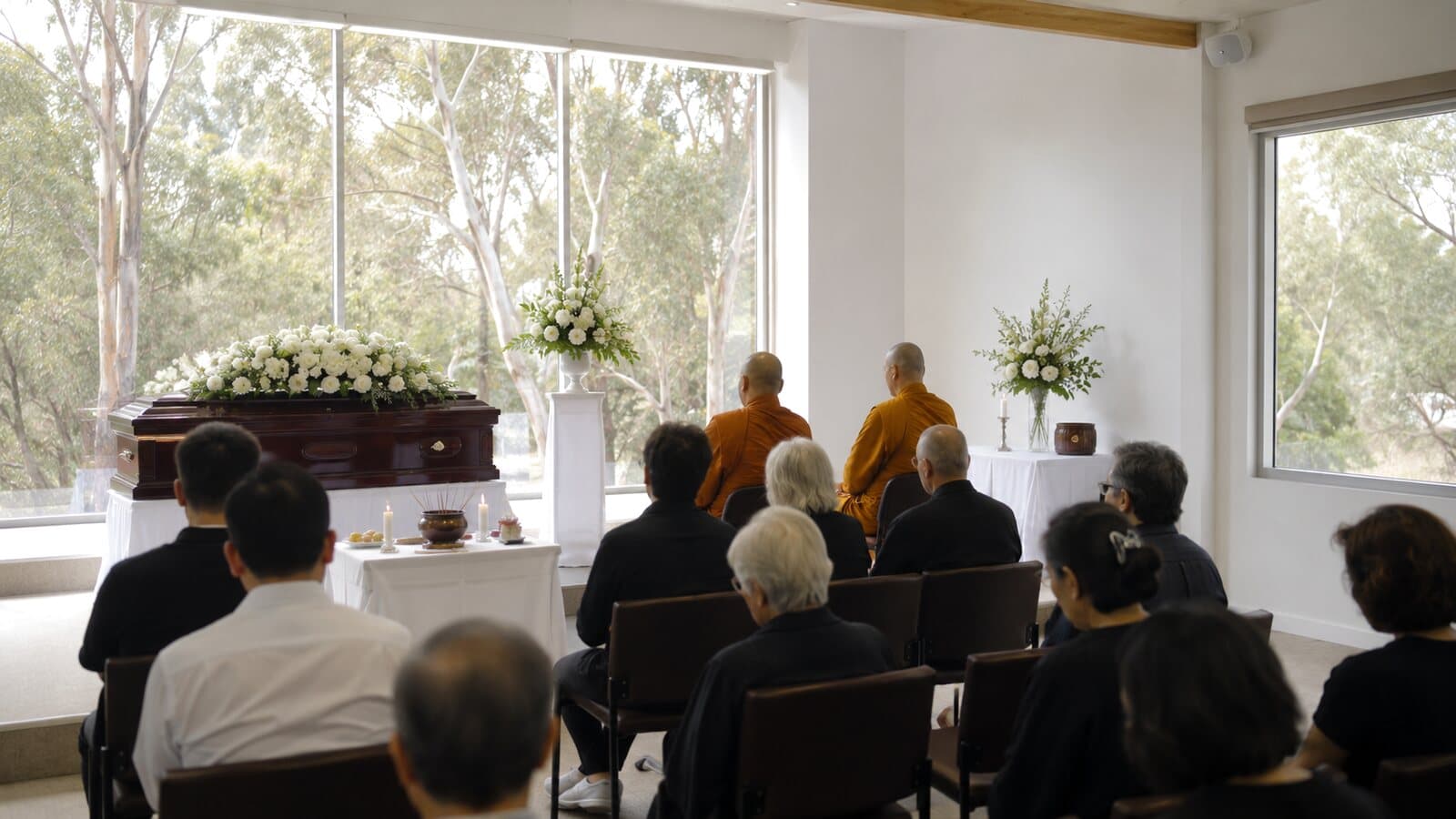
What happens at a Buddhist funeral in Australia?
Buddhism treats death as a transition within samsara, the cycle of death and rebirth, rather than a final ending. Funeral rites across the Buddhist schools aim to support the deceased's consciousness as it moves from this life toward rebirth or, for those who have achieved it, nirvana.
Customs and key terms
| Cremation or burial | Cremation is customary across all schools, following the precedent of Gautama Buddha. Burial is permitted but uncommon. |
| Mourning period | 49 days (Mahayana and Tibetan). Theravada marks the 3rd, 7th, 49th and 100th days. |
| Key terms | Bardo (intermediate state between death and rebirth, specifically Tibetan/Vajrayana), Pamsukula (forsaken robe offered to monks), An ling/Ji ling (arrangements for the spirit tablet during the Chinese Mahayana mourning period) |
| Point often misunderstood | The assumption that Buddhists do not mourn or express grief. Families grieve openly, and structured memorial periods support that process. |
| Dress code for guests | White or muted colours. Black is acceptable in some traditions. Avoid bright colours, particularly red. Remove shoes if the service is in a temple. |
Australia's Buddhist community practises three broad traditions, each with distinct funeral customs. Theravada Buddhism (predominant among Thai, Sri Lankan, Burmese and Cambodian communities), Mahayana Buddhism (Chinese, Vietnamese, Korean and Japanese communities), and Vajrayana or Tibetan Buddhism each approach death with different rituals, texts and timelines. Cremation, chanting, merit-making for the deceased, and structured memorial periods are consistent across all three.
The Buddhist Council of New South Wales and the Australian Sangha Association can help families arrange funerals within their specific tradition.
Theravada funeral rites
In the Theravada tradition, monks begin chanting while the person is still dying. In Thai and Lao Theravada communities, monks often chant from the Abhidhamma at the bedside and through the funeral. Sri Lankan and Burmese funerals more commonly use paritta or sutta chanting rather than Abhidhamma. There is no single Theravada funeral text, so the chosen recitations vary by country of origin.
The family washes the body and pours scented water over one hand of the deceased as a gesture of respect and farewell. The hands and feet are bound with white thread, which monks later hold during the funeral procession, linking the sangha (monastic community) to the deceased.
A Pamsukula (forsaken robe) is offered to the monks during the ceremony. Offering robes and food to monks generates merit (punna) that is dedicated to the departed. Buddhists believe this merit eases the deceased's passage through rebirth.
Cremation follows. In some Theravada communities, a monk delivers a sermon to the family at their home within the first week after death, though the precise timing varies by tradition and country of origin. Thai, Sri Lankan, Burmese, and Cambodian communities each observe slightly different customs in this period. Memorial services are then held on the 3rd, 7th, 49th and 100th days after death.
Mahayana funeral rites
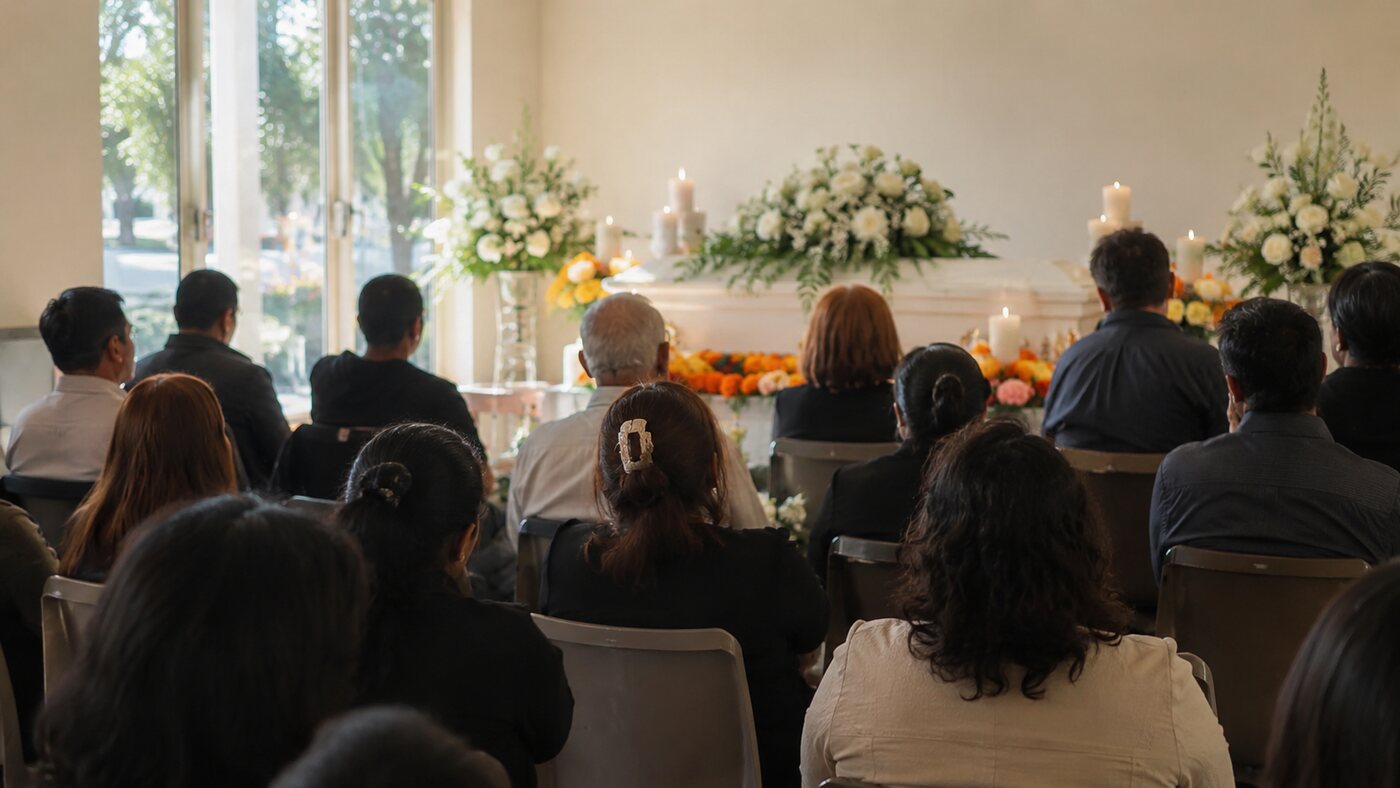
Mahayana funerals typically last three to seven days and are often held at funeral parlours rather than in the family home. The atmosphere is formal and structured around continuous chanting.
Monks or lay practitioners chant the Amitabha Sutra to invoke Amitabha Buddha and guide the deceased toward the Pure Land (Sukhavati, the buddha-field of Amitabha, understood as a realm where all conditions are ideal for attaining enlightenment). Vegetarian meals and joss sticks (incense) are offered throughout the mourning period.
A spirit tablet (lingwei) is set up at the service to represent the deceased and receive offerings and prayers. Families in Chinese Buddhist communities then choose between two arrangements for the 49-day mourning period: an ling (安灵, "settling the spirit"), where the tablet and offerings are maintained at the family home; or ji ling (寄灵, "lodging the spirit"), where the tablet is placed at a temple, monastery or columbarium so that monks or caretakers can perform daily chanting and offerings on the family's behalf. Once the mourning period ends, the spirit tablet is transferred to a permanent position at the family altar or at a temple for ongoing ancestral veneration.
During the 49-day period, East Asian Mahayana Buddhists believe the consciousness passes through an intermediate state (in Sanskrit antarabhava; in Chinese zhongyin), where karmic conditions determine rebirth. This belief is often associated with the Ksitigarbha (Earth Store) Sutra. The Tibetan term bardo belongs to the Vajrayana tradition. The family holds weekly rites on each seventh day, making offerings and chanting to generate merit for the departed.
Tibetan Buddhist funeral rites
Tibetan (Vajrayana) Buddhist funerals follow the Bardo Thodol, commonly known in English as the Tibetan Book of the Dead. This text is read to the dying person before death and then recited for 49 days afterward to guide the consciousness through the bardo.
Tibetan Buddhists believe the consciousness can hear and respond to the instructions in the text, and that the guidance helps it move through the visions and experiences of the intermediate state. A lama (teacher) or monk leads the recitations.
In Tibetan tradition it is important not to touch or move the body immediately after death, as the consciousness is understood to remain in the body for a period that can extend up to three days. Families and carers are advised to keep the environment calm and to avoid disturbing the body until signs of the consciousness departing are observed. In diaspora settings like Australia this may not always be practically possible, and families should discuss their wishes with the funeral director as early as possible.
Offerings are made to monks throughout the 49-day period. Sky burial, known as jhator or giving alms to the birds, treats offering the body to vultures as a final act of generosity. It is not practised in Australia and is not permitted here. Some families may keep symbolic gestures connected to that tradition, though customs in the diaspora vary.
Theravada, Mahayana and Tibetan practices compared
| Theravada | Mahayana | Tibetan (Vajrayana) | |
|---|---|---|---|
| Communities in Australia | Thai, Sri Lankan, Burmese, Cambodian | Chinese, Vietnamese, Korean, Japanese | Tibetan |
| Primary text | Paritta or Abhidhamma, varies by country (Abhidhamma common in Thai and Lao practice) | Amitabha Sutra | Bardo Thodol (Tibetan Book of the Dead) |
| Language of chanting | Pali | Chinese or Japanese | Tibetan |
| Key ritual | Pamsukula (robe offering to monks) | Spirit tablet (lingwei) with an ling/ji ling arrangements during the 49-day period | Reading of the Bardo Thodol to the dying and deceased |
| Mourning timeline | Theravada memorial timing varies by country of origin. Observances are commonly held around the 7th day, the 49th or 50th day, and the 100th day, with some communities also marking other days. Confirm the specific pattern with the family or temple. | 49 days, with weekly rites every seventh day | 49 days of continuous recitation |
| Destination for the deceased | Rebirth determined by karma and merit | Pure Land (domain of Amitabha Buddha) | Liberation or guided rebirth through the bardo |
Swipe the table sideways to see every column.
Cremation and burial
Cremation is customary across all Buddhist schools, following the precedent set by Gautama Buddha, whose body was cremated after his death. It is not an absolute religious requirement. Burial is permitted.
In Australia, Buddhist cremations take place at standard crematoria. Some temples have relationships with specific funeral homes and crematoria that are familiar with Buddhist rites and can accommodate the chanting, offerings and extended family gatherings that are part of the ceremony.
The Chenrezig Institute in Queensland (chenrezig.com.au) and the Great Stupa of Universal Compassion near Bendigo in Victoria (stupa.au) are two significant Tibetan Buddhist centres in Australia that can advise families on funeral arrangements within the Vajrayana tradition.
The 49-day mourning period
Mahayana and Tibetan traditions mark 49 days (seven weeks of seven days) as the period during which the consciousness transitions between death and rebirth.
The family holds weekly memorial services, making offerings of food, incense and prayers at the home altar or temple. Vegetarian meals are the norm. Social events and celebrations are avoided.
Theravada traditions follow a different timeline, with key memorial observances on the 3rd, 7th, 49th and 100th days. Some families also hold annual memorial services (matakabhatta, or food for the dead) on the anniversary of the death.
The mourning period also serves the living. Families practise generosity, reflect on impermanence, and generate merit through acts of charity and devotion. Donations to temples, feeding monks, and supporting community organisations are all considered meritorious.
What to expect if you are attending
Buddhist funerals are open to non-Buddhist guests. The atmosphere is quiet and contemplative. Chanting is conducted in Pali (Theravada), Chinese or Japanese (Mahayana), or Tibetan, depending on the tradition.
Dress in white or muted colours. In some traditions, black is also appropriate, but avoid bright colours (particularly red, which is associated with celebration and joy). Remove shoes if the service is held in a temple.
You are not expected to chant or recite prayers. Observe respectfully, follow the lead of the family, and offer condolences quietly. Bowing slightly with palms pressed together (the anjali or wai gesture) is a respectful greeting but is not required of non-Buddhist guests.
Flowers (white or yellow are preferred) and fruit are appropriate offerings. Some families request donations to a temple or charity in lieu of flowers.
A common misconception is that Buddhists do not mourn or express grief. The Buddha did not prohibit lay followers from expressing respect and sorrow through local customs. Families grieve openly, and the structured mourning period provides a framework for processing loss over weeks rather than days.
Glossary
| Term | Meaning |
|---|---|
| Samsara | The cycle of death, rebirth and suffering in Buddhist cosmology |
| Bardo | The intermediate state between death and rebirth. The term bardo is specifically Tibetan (Vajrayana). The Mahayana term for the intermediate state is antarabhava (Sanskrit). |
| Punna (merit) | Positive spiritual credit generated through good actions, offerings and generosity |
| Pamsukula | A forsaken robe offered to monks at Theravada funerals as an act of merit-making |
| Ji ling (寄灵) | The practice of lodging the spirit tablet at a temple, monastery or columbarium during the 49-day mourning period so that monks or caretakers can perform daily chanting and offerings on the family's behalf |
| An ling (安灵) | The practice of settling the spirit tablet and offerings at the family home during the 49-day mourning period; also used broadly to refer to the entire post-death ritual period in Chinese Buddhist communities |
| Bardo Thodol | The Tibetan Book of the Dead, read to guide the consciousness through the intermediate state |
| Sangha | The monastic community of monks and nuns |
| Anjali (wai) | A greeting made by pressing the palms together and bowing slightly |
Further reading
- Buddhist funeral - Wikipedia - Overview of funeral rites across Theravada, Mahayana and Vajrayana traditions with country-specific detail
- Bardo Thodol - Britannica - Authoritative summary of the Tibetan Book of the Dead, its structure and ritual use
- Pure Land Buddhism - Wikipedia - Background on Amitabha Buddha, Sukhavati and the role of the Pure Land in East Asian Mahayana funerary practice
- Transfer of merit - Wikipedia - Explains the Buddhist doctrine of merit-making and dedication to the deceased across Theravada and Mahayana traditions
- Australian Sangha Association - Peak body representing Buddhist monks and nuns of all traditions in Australia; can assist with connecting families to appropriate clergy
Related information
- How much does a cremation cost in Australia?
- How much does a funeral cost in Australia?
- Same-day funeral logistics (Muslim, Jewish, Hindu)
- Find a Buddhist funeral director
- Back to all guides
Frequently asked questions
Do Buddhists require cremation?
How long is the Buddhist mourning period?
What should I wear to a Buddhist funeral?
Can non-Buddhists attend a Buddhist funeral?
What is the significance of the spirit tablet?
This guide is general information to help Australian families, editorially reviewed by the Funerals Direct team from publicly available sources. It is not legal or financial advice. Funeral prices change and vary by provider and region, so always ask for an itemised written quote. For prepaid funerals, bonds, or insurance, consider speaking with an independent financial adviser or a free financial counsellor on 1800 007 007.
Ready to find a funeral director?
Compare directors who list the right experience, read reviews from other families, and request a quote. Always free for families.
Find a Buddhist funeral directorWas this guide helpful?