What happens at a Jewish funeral in Australia?
Jewish funerals follow one of the most structured sequences of any faith tradition. Every step, from the moment of death through to the end of the mourning period, is governed by halacha (Jewish law). The rites prioritise dignity for the deceased, rapid burial, and communal support for the grieving family.
In Australia, Jewish funerals are coordinated through the Chevra Kadisha, the community's dedicated burial society. The Sydney Chevra Kadisha and the Melbourne Chevra Kadisha both operate as not-for-profit funeral providers, using trained volunteers to carry out the religious requirements.
The mourning period has several stages:
| Stage | Duration | What it involves |
|---|---|---|
| Shiva | 7 days from burial | Family stays home, sits on low chairs, covers mirrors, receives visitors |
| Shloshim | 30 days | Joyous events avoided, work resumes, daily Kaddish at synagogue |
| First year | Mourning a parent | Kaddish daily for 11 months, headstone unveiled around the first anniversary |
Immediately after death
The period between death and burial is called aninut. A close relative in this state is known as an onen and is released from normal religious duties like daily prayer, so that arranging a prompt burial becomes their main focus.
Traditionally the eyes and mouth are closed and the body is covered with a sheet, with a candle lit nearby. In Australia the Chevra Kadisha usually collects the body promptly and carries out this care at their own facility. From this point until burial, the body is never left alone.
The shomer (watcher)
A shomer sits with the body at all times between death and burial. The shomer may be a family member, a friend, or a volunteer from the Chevra Kadisha. The role is both practical (making sure the body is treated with respect) and spiritual (the soul is believed to remain near the body until burial).
The shomer traditionally recites Psalms during the watch. In Australian practice, the Chevra Kadisha can provide volunteer shomrim (plural) to cover the watch in shifts, particularly overnight.
Tahara (ritual purification)
Before burial, the body undergoes tahara, a ritual washing performed by members of the Chevra Kadisha. Men wash men; women wash women. The washing follows a precise sequence: the body is cleansed with warm water, prayers are recited, and the body is dressed in tachrichim (simple white linen or cotton shrouds).
The tachrichim have no pockets, no adornment, and no distinction of wealth. Everyone is buried in the same plain garments, reflecting the principle that all are equal in death. In some communities, a man is also wrapped in his tallit (prayer shawl) with one of the fringes cut to indicate it is no longer used for prayer.
The tahara is performed with great care and dignity. The body is never turned face-down, and conversations during the procedure are limited to the task at hand.

The casket
Orthodox practice calls for a plain wooden coffin with no metal nails, hinges or handles, so the body and coffin can return to the earth together. Ornate coffins, metal caskets, and above-ground mausoleums or vaults are not permitted in Orthodox practice. Reform and Progressive families may take a more flexible approach.
The casket remains closed at all times. Open-casket viewings are considered extremely disrespectful in Jewish tradition, even for family.
The funeral service
Jewish funerals are typically held at a funeral chapel, synagogue, or at the graveside. The service is simple and focused.
K'riah (tearing of garments). Before the service, immediate family members tear a section of their clothing (or a ribbon pinned to their clothing) as a visible sign of grief. This is done standing, symbolising that the mourner faces grief upright.
Psalms. The service opens with Psalms, most commonly Psalm 23 ("The Lord is my shepherd") and Psalm 91.
Hesped (eulogy). One or more eulogies are delivered, typically by the rabbi, family members, or close friends. The hesped honours the life of the deceased and expresses the community's loss.
El Malei Rachamim. The cantor or rabbi chants this prayer, asking God to grant the soul rest under the wings of the Divine Presence. It is one of the most recognisable elements of a Jewish funeral.
There is no music at a Jewish funeral. No flowers are displayed at the service or the grave. Charity donations in memory of the deceased are the preferred alternative to flowers.
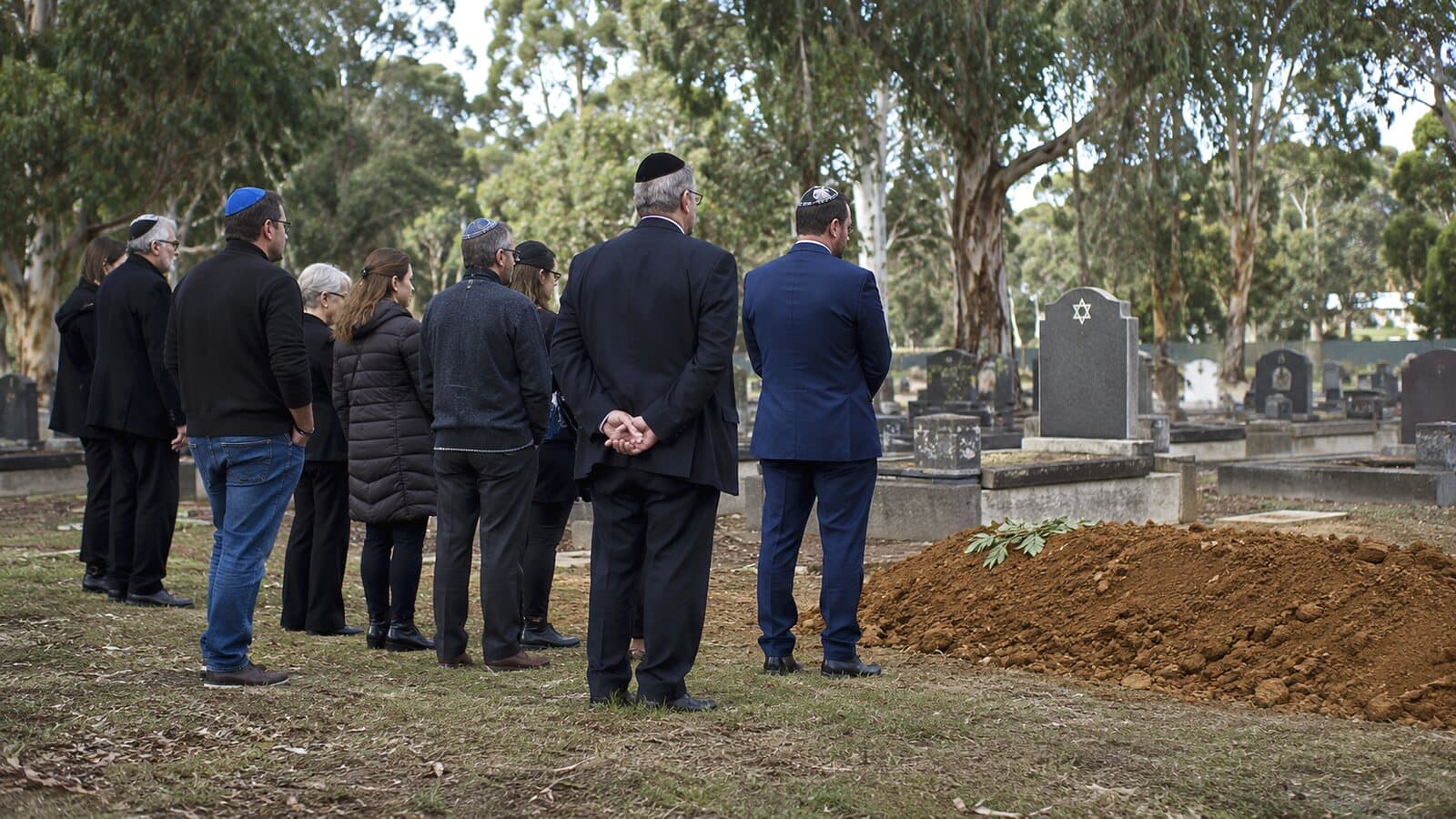
At the cemetery
The funeral procession (levaya) moves from the service to the grave. The coffin is carried by pallbearers, often pausing seven times on the way to the grave (representing the seven times the word "hevel," meaning vanity or breath, appears in Ecclesiastes).
At the graveside, the coffin is lowered into the ground and attendees take turns shovelling earth onto it. The shovel is not passed from hand to hand. Instead, it is placed back into the pile of earth between turns. This custom reflects the reluctance to "pass on" grief from one person to another.
Once the grave is filled (or partially filled), the mourners recite Kaddish, the prayer of sanctification. The congregation forms two parallel lines, and the mourners walk between them while receiving words of comfort: "May God comfort you among the mourners of Zion and Jerusalem."
Before leaving the cemetery, attendees wash their hands from a pitcher of water placed near the exit. This is a ritual act of transition from the world of death back to the world of the living.
Shiva (7 days of mourning)
Shiva begins immediately after the burial and lasts seven days (shiva means "seven" in Hebrew). The mourning family stays at home, traditionally the home of the deceased or a family member's home.
In traditional observance the family sits on low chairs, covers mirrors in the home, refrains from work, and avoids leather shoes and bathing for pleasure. How closely a family keeps these customs varies, and Reform and Progressive families may observe some or none of them. A memorial candle burns for the full seven days.
Community members visit throughout shiva to offer comfort. Visitors bring food, and meals are prepared for the family so they do not need to cook. The first meal after the funeral (seudat havra'ah, the meal of consolation) traditionally includes round foods like eggs and lentils, symbolising the cycle of life.
The visitor's role during shiva is to follow the mourner's lead. If the mourner wants to talk about the deceased, the visitor listens. If the mourner is silent, the visitor sits quietly. There is no expectation that the mourner should be cheerful or put on a brave face.
Shloshim and the first year
After shiva ends, the mourning period continues at a reduced intensity.
Shloshim (30 days). For the first 30 days after burial, mourners avoid joyous events like weddings, concerts, and parties. Men do not shave or get haircuts during shloshim. Normal work resumes, but the mourner continues to recite Kaddish daily at synagogue.
The first year. Those mourning a parent observe a full year of mourning. Kaddish is recited daily for 11 months. The unveiling of the headstone (matzeivah) typically takes place around the first anniversary of the death, though the timing varies by community. The anniversary of the death (yahrzeit) is observed annually with the lighting of a memorial candle and the recitation of Kaddish.
Cremation
Orthodox and Conservative Judaism both prohibit cremation. The prohibition is deeply held: the body is returned to the earth intact so that it may be raised at the resurrection, and extensive rabbinic literature from the Torah through later authorities requires burial rather than burning.
In Orthodox practice, a person who chooses cremation may be denied traditional Jewish burial rites, though rabbinical authorities have some pastoral discretion in difficult circumstances. The Conservative movement also prohibits cremation; a Conservative rabbi may choose whether to officiate at a ceremony prior to cremation, but according to a 1986 ruling by the Conservative movement's legal authorities, should not officiate at the interment of cremated remains if the family declined rabbinical advice against cremation.
Reform and Progressive Judaism take a different position. The most recent Reform responsum states that while cremation ought to be discouraged, the practice is not considered sinful, and Reform rabbis may officiate at funerals where cremation is to take place. The Reform movement also accepts cremated remains in Jewish cemeteries. Traditional burial remains the encouraged option across all branches. Families should confirm the position of their own rabbi or community.
The Chevra Kadisha in Australia
Both the Sydney Chevra Kadisha and the Melbourne Chevra Kadisha operate as not-for-profit community organisations. They provide funeral services at community cost, using trained volunteers for tahara, shomrim duties, and graveside assistance. Both publish a schedule of charges and aim to keep costs affordable rather than to make a profit.
For families outside Sydney and Melbourne, local rabbis can advise on burial arrangements and connect families with volunteers who can perform tahara and other rites.
What to expect if you are attending
Jewish funerals are open to non-Jewish guests. Men may be offered a kippah (head covering) at the door; wearing it is a sign of respect but not compulsory for non-Jews. Dress formally in dark or muted colours.
Do not send flowers. Make a donation to a nominated charity or bring food to the shiva house instead. Do not expect an open casket. Do not take photos at the funeral or cemetery.
If you attend shiva, follow the mourner's lead. Sit with them, listen, and do not try to minimise their grief with phrases like "they are in a better place." Practical help (bringing food, running errands) is more valued than words.
Related information
- Same-day funeral logistics (Muslim, Jewish, Hindu)
- How much does a funeral cost in Australia?
- Non-religious and secular funeral ceremonies
- Find a Jewish funeral director
- Back to all guides
Further reading
- Jewish views on cremation - My Jewish Learning: covers Orthodox, Conservative, and Reform positions with source references.
- Aninut: between death and burial - My Jewish Learning: explains the onen status and the obligations it suspends.
- Sheloshim: the bridge to a new normal - My Jewish Learning: the 30-day mourning period explained by Rabbi Scott Perlo.
- Timeline of Jewish mourning - My Jewish Learning: a structured overview from aninut through yahrzeit.
- Union for Progressive Judaism: death and mourning - Union for Progressive Judaism (Australia): guidance on mourning practices within the Progressive movement in Australia.
Frequently asked questions
What happens at a Jewish funeral?
Does Judaism allow cremation?
What is shiva?
Should I bring flowers to a Jewish funeral?
What is the Chevra Kadisha?
This guide is general information to help Australian families, editorially reviewed by the Funerals Direct team from publicly available sources. It is not legal or financial advice. Funeral prices change and vary by provider and region, so always ask for an itemised written quote. For prepaid funerals, bonds, or insurance, consider speaking with an independent financial adviser or a free financial counsellor on 1800 007 007.
Ready to find a funeral director?
Compare directors who list the right experience, read reviews from other families, and request a quote. Always free for families.
Find a Jewish funeral directorWas this guide helpful?