What happens at an Eastern Orthodox funeral in Australia?
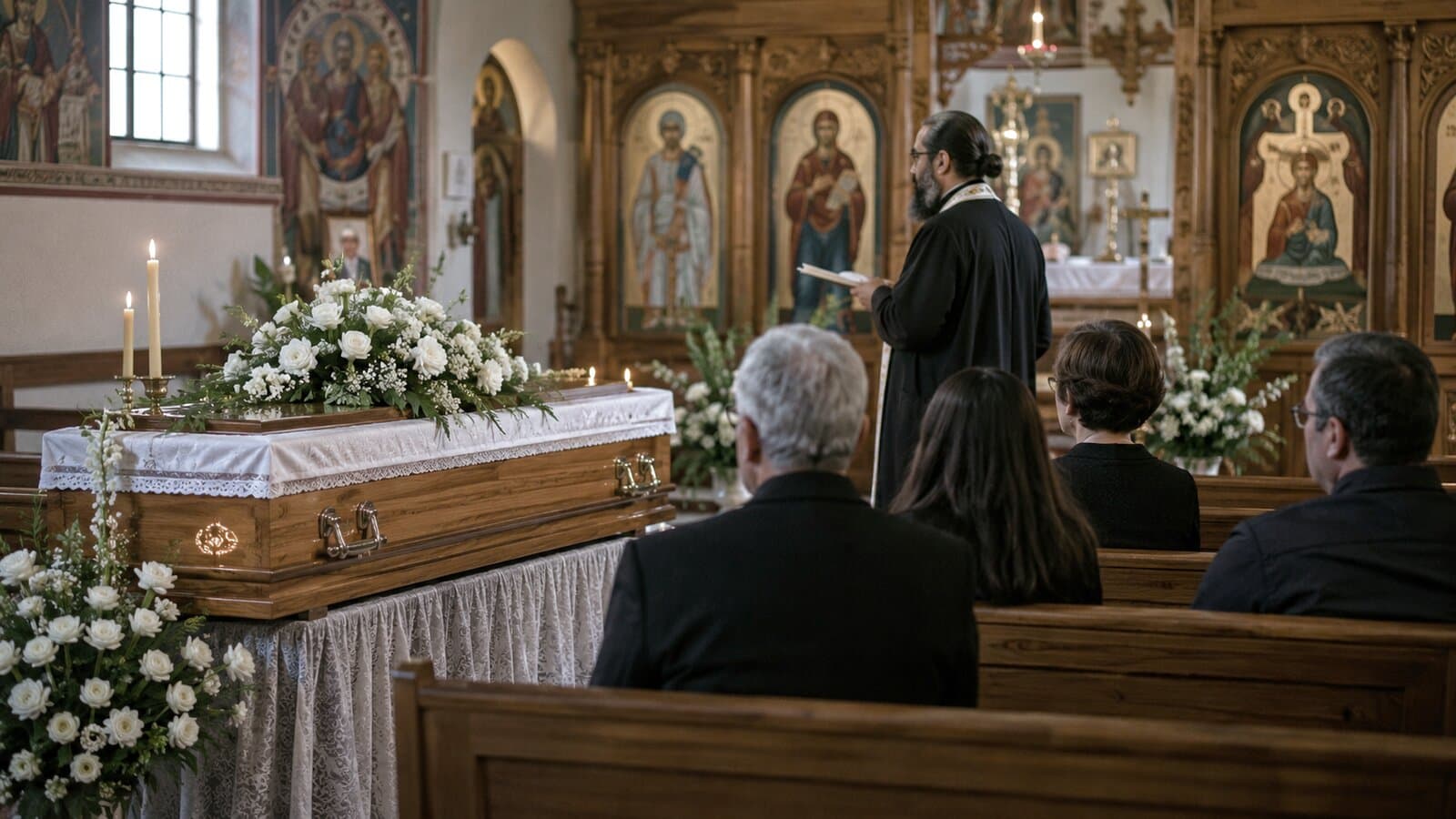
Orthodox Christian funerals rest on the belief that the body will rise again. Because of this, the body is treated as a temple of the Holy Spirit. The traditions teach against cremation, the casket usually stays open, and the body faces east, toward the direction from which Christ is expected to return.
Russian Orthodox, Serbian Orthodox, and Coptic Orthodox communities each follow distinct funeral customs drawn from their own liturgical traditions, cultural practices, and histories. All three operate parishes in every major Australian city. The Coptic Orthodox Church belongs to the Oriental Orthodox communion (separate from the Eastern Orthodox communion of the Russian and Serbian churches), but all three share the same prohibitions on cremation and the same open-casket practice.
The Australia and New Zealand Diocese of the Russian Orthodox Church Outside of Russia publishes guidance for Russian Orthodox families arranging funerals.
Shared Orthodox funeral elements
Every Orthodox funeral follows a recognisable pattern.
Trisagion and pre-funeral vigil. The Trisagion ("Holy God, Holy Mighty, Holy Immortal, have mercy on us") is a central hymn sung throughout Orthodox funeral and memorial rites. In the evening before the funeral, the priest leads a memorial service (Panikhida or abbreviated Trisagion service) at the family home or at the church. Candles are lit, and family and community gather around the open casket. The continuous reading of the Psalter alongside the body is also traditional in Russian Orthodox practice during this period.
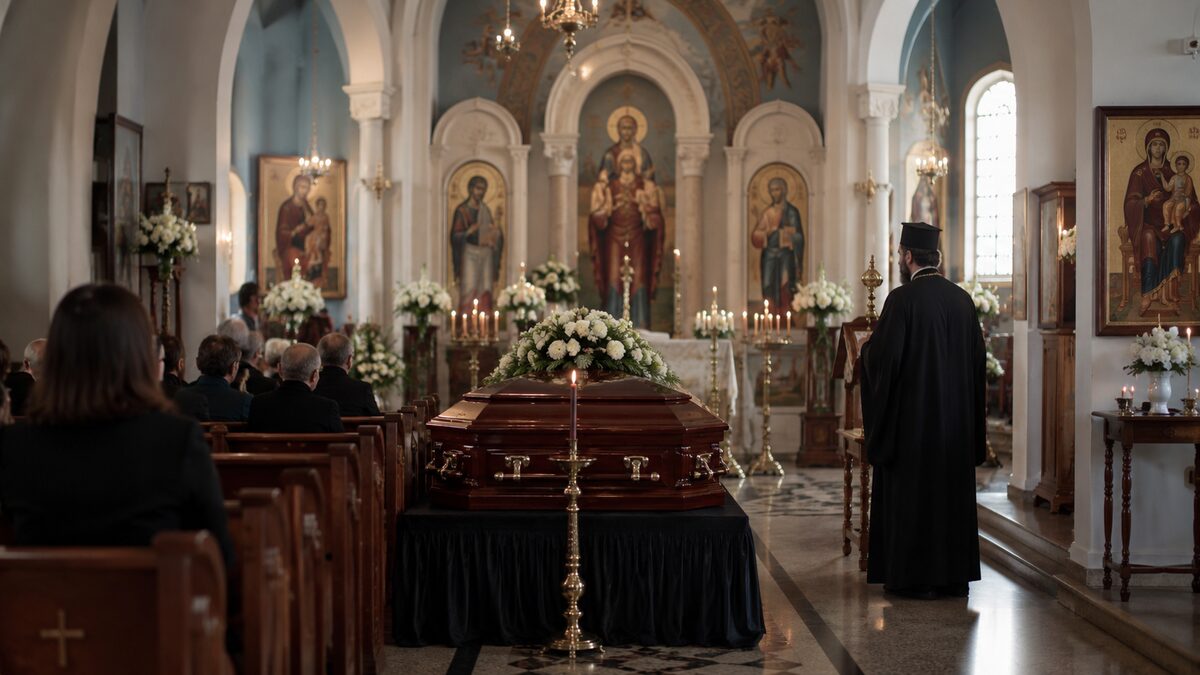
Open casket. The casket stays open throughout the church service. The family places an icon on the chest of the deceased, typically of Christ or the patron saint. Mourners approach the casket to pay their respects, often kissing the icon or the forehead of the deceased. The casket is closed just before the procession to the cemetery.
Church service. The priest conducts the full funeral service with chanting, scripture readings, and prayers for the repose of the soul. The service is sung, not spoken. Russian Orthodox services run approximately one to two hours. Serbian and Coptic services may differ in length.
Burial. The body is buried facing east. The priest pours a mixture of wine and oil over the lowered coffin. The priest and family members cast earth onto the casket. A cross marks the grave.
Cremation. Orthodox tradition teaches against cremation, and the body is buried whole. In practice this is treated as a firm requirement rather than a family choice, so Orthodox families and the funeral directors working with them generally plan for burial from the outset.
Russian Orthodox customs
Russian Orthodox funeral rites follow the liturgical traditions of the Russian Church. The Panikhida, a memorial prayer service for the departed, sits at the heart of these rites. It is shorter than a full funeral service and can be held at multiple points: on the day of death, before the funeral, and at each prescribed memorial interval.
Kollyva (boiled wheat mixed with honey, nuts, and dried fruit) is prepared and blessed during the memorial service. It symbolises the resurrection: the grain dies in the earth and rises again as a new plant. Mourners receive kollyva after the service.
The memorial cycle follows a fixed schedule:
| Interval | Occasion |
|---|---|
| 3rd day | First memorial service after death |
| 9th day | Second memorial |
| 40th day | Most significant memorial; traditionally linked to the soul's particular judgement |
| 3 months | Quarterly memorial |
| 6 months | Half-year memorial |
| 9 months | Quarterly memorial |
| 12 months | First anniversary |
| Annually | Anniversary of death, ongoing |
Russian Orthodox families traditionally wore black mourning attire for a full year or longer. In Australia, wearing black for approximately six weeks is the accepted norm, adapted to Australian social expectations.
Serbian Orthodox customs
Serbian Orthodox funerals include elements specific to Serbian cultural tradition, particularly the connection between funeral customs and the Slava, the family's patron saint day.
The funeral service follows the standard Orthodox structure (Trisagion, open casket, church service, burial facing east). After the burial, the family hosts a post-funeral meal called the Daca for all mourners. The Daca is a substantial gathering with food, drink, and remembrance of the deceased.
Zadusnice (cemetery visits) mark another important Serbian practice. The family visits the grave at regular intervals, bringing food, flowers, and candles. These visits fall on set dates in the church calendar, including the four annual Soul Saturdays (Zadusnice), and on memorial anniversaries.
The Slava is a distinctly Serbian Orthodox tradition, also found in parts of Bulgarian, Albanian, and some Greek and Romanian communities: the annual celebration of the family's patron saint. When a family member dies, the Slava and mourning customs overlap. The family offers koljivo (boiled wheat, the Serbian equivalent of the Russian kollyva) for the souls of deceased members during the Slava celebration. The priest blesses the koljivo, and the Slava meal includes prayers for the departed.
Serbian memorial services follow the same calendar as Russian Orthodox: 3rd, 9th, and 40th days, then at 3, 6, 9, and 12 months, and yearly.
Coptic Orthodox customs
Coptic Orthodox Christians (predominantly Egyptian in origin) follow funeral rites within the Coptic liturgical tradition. Australia's Coptic community has grown substantially, with churches in Sydney, Melbourne, Brisbane and other cities.
Coptic funerals follow the broader Orthodox structure: open casket, church service with chanting and prayers, and burial facing east. The priest conducts the service in Coptic (a descendant of ancient Egyptian), Arabic, and English.
For 40 days after the death, the family receives visitors, the community offers prayers daily, and practical and emotional support flows from the parish. The 40th-day memorial brings the family and community together for a church service and gathering.
Coptic Orthodox families hold strictly to the prohibition on cremation. Secular music and non-liturgical elements are not permitted during the funeral service.
Russian vs Serbian vs Coptic: key differences
| Russian Orthodox | Serbian Orthodox | Coptic Orthodox | |
|---|---|---|---|
| Liturgical language | Church Slavonic | Church Slavonic / Serbian, with English increasingly used in Australian parishes | Coptic / Arabic / English |
| Memorial wheat | Kollyva | Koljivo | Not standard |
| Post-funeral meal | Pominki (memorial meal) | Daca | Family gathering |
| Unique custom | Panikhida prayer service | Slava (patron saint day) | 40-day daily prayer cycle |
| Cemetery visits | Anniversary-based | Zadusnice (Soul Saturdays, four per year) | 40th day and anniversaries |
| Mourning dress (AU) | Black, approx. 6 weeks | Black, approx. 6 weeks | Black, 40 days or longer |
| Cremation | Forbidden | Forbidden | Forbidden |
Swipe the table sideways to see every column.
Common misconceptions
Several assumptions that non-Orthodox guests bring to Orthodox funerals are wrong.
"The family can choose cremation if it is cheaper." Orthodox practice does not generally allow cremation regardless of cost, and an Orthodox church will typically decline to conduct funeral rites for a person who is to be cremated.
"The casket can be closed during the church service." In most Orthodox traditions, the open casket is standard during the church service. Closing it early is not the norm, though specific circumstances (like the condition of the body) may require it.
"Secular songs or personal eulogies are part of the service." Orthodox funeral services are liturgical. The church prescribes the content. Secular music, personal speeches, and non-religious readings do not belong in the church service. A separate gathering or wake after the burial may include personal remembrances.
What to expect if you are attending
Orthodox funerals welcome non-Orthodox guests. Dress conservatively in dark colours (black is standard). Women may be asked to cover their heads in some parishes; bring a scarf to be safe.
Stand when the congregation stands. Orthodox church services involve a lot of standing, and seating may be limited. You do not need to cross yourself, venerate icons, or join in the prayers if you are not Orthodox. Observe respectfully.
When approaching the open casket, you may bow or pause respectfully. You are not required to kiss the icon or the deceased. Follow the lead of the people in front of you.
After the burial, the family typically hosts a meal. Attending the meal is considered respectful and supportive.
Terminology glossary
| Term | Tradition | Meaning |
|---|---|---|
| Trisagion | All Orthodox | The "Thrice-Holy" hymn ("Holy God, Holy Mighty, Holy Immortal, have mercy on us") central to Orthodox funeral and memorial rites. A shortened memorial service known as the Trisagion service is often held the evening before the funeral. In Oriental Orthodox churches (including Coptic), the Trisagion adds "who was crucified for us." |
| Panikhida | Russian | Memorial prayer service for the departed, shorter than a full funeral service. |
| Kollyva | Russian | Boiled wheat with honey, nuts, and dried fruit, blessed at memorial services. Symbolises resurrection. |
| Koljivo | Serbian | Serbian equivalent of kollyva, offered during memorials and the Slava. |
| Daca | Serbian | Post-funeral meal hosted by the family for all mourners. |
| Slava | Serbian | Annual celebration of the family's patron saint, primarily a Serbian Orthodox custom also found among some Bulgarian, Albanian, and other Balkan Orthodox families. |
| Zadusnice | Serbian | Scheduled cemetery commemorations, including four annual Soul Saturdays. |
| Pominki | Russian | Memorial meal held after the funeral or at memorial intervals. |
Related information
- Greek Orthodox funerals in Australia
- How much does a funeral cost in Australia?
- Back to: Australian funeral traditions
Further reading
- Australian and New Zealand Diocese of the Russian Orthodox Church Outside Russia - Official diocesan site for ROCOR parishes in Australia; publishes guidance for Russian Orthodox families arranging funerals.
- OrthodoxWiki: Memorial Services - Encyclopedic overview of memorial service practice, the Panikhida, kollyva, and prescribed commemoration intervals across Orthodox traditions.
- OrthodoxWiki: Kollyva - Origins, symbolism, and preparation of the ritual wheat offering used at Orthodox memorial services.
- OrthodoxWiki: Slava - Background on the Serbian patron saint celebration and its connection to mourning customs.
- Wikipedia: Memorial service in the Eastern Orthodox Church - Detailed overview of the Panikhida/Parastas service, including the full memorial cycle and Soul Saturdays.
Frequently asked questions
Is cremation permitted in Orthodox Christianity?
Why is the casket open?
What is the 40th-day memorial?
How long do you wear black?
What is koljivo?
This guide is general information to help Australian families, editorially reviewed by the Funerals Direct team from publicly available sources. It is not legal or financial advice. Funeral prices change and vary by provider and region, so always ask for an itemised written quote. For prepaid funerals, bonds, or insurance, consider speaking with an independent financial adviser or a free financial counsellor on 1800 007 007.
Ready to find a funeral director?
Compare directors who list the right experience, read reviews from other families, and request a quote. Always free for families.
Find a funeral directorWas this guide helpful?