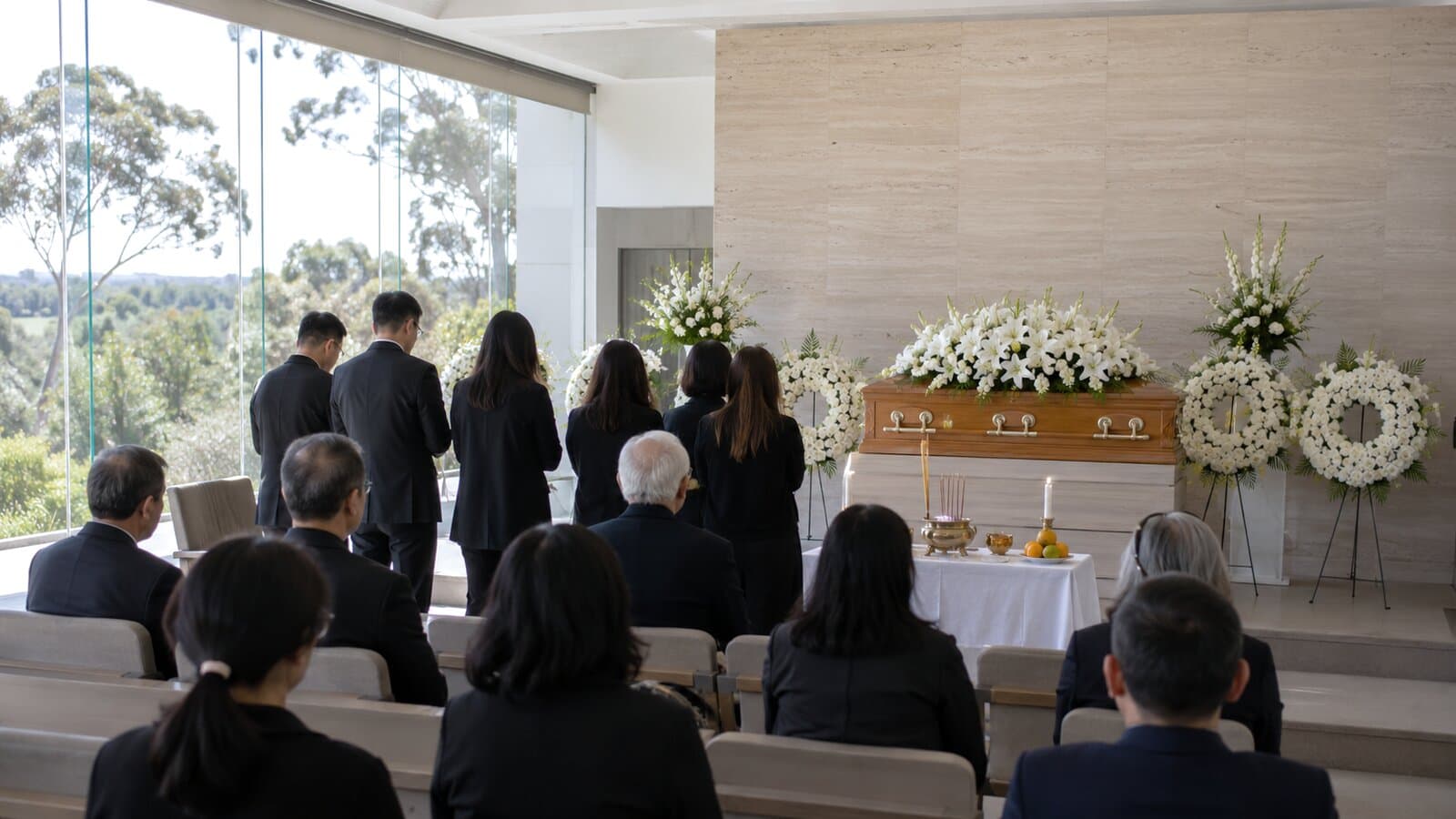
What happens at a Chinese Australian funeral?
Chinese funerals in Australia draw from a blend of Taoist, Buddhist and Confucian beliefs that have evolved over thousands of years. For many Chinese Australian families, the funeral is less a religious event in the Western sense than a set of cultural practices rooted in filial piety (xiao), the obligation to honour and care for parents and ancestors, that cuts across religious boundaries. Many Chinese Australian families are Christian or non-religious and may hold a Western-style or secular service instead.
A family may incorporate Taoist priests, Buddhist monks, and secular elements into a single funeral service. The combination depends on the family's regional background, generation, and level of religious observance.
Community organisations and Chinese-speaking funeral directors can provide culturally appropriate guidance for families.
Key terms
| Term | Pronunciation guide | Meaning |
|---|---|---|
| Xiao | "shee-ow" | Filial piety; the obligation to honour parents and ancestors |
| Joss paper | English term | Spirit money burned as offerings for the deceased in the afterlife |
| Ling paai | "ling pie" | Spirit tablet inscribed with the deceased's name, focal point for prayers |
| Zuo Qi | "dzwoh chee" (Mandarin); also written zuoqi | The 49-day mourning cycle with rites every seven days |
| Kam taap | "kahm tahp" | Ceramic funerary urns used for re-interment of bones |
| Qingming | "ching ming" | Tomb Sweeping Day, annual festival for visiting and tending ancestors' graves |
| Feng shui | "fung shway" | Practice of arranging environments to harmonise energy; applied to grave selection |
Preparation of the body
When a Chinese Australian person dies, the family often washes the body and dresses the deceased in their finest clothes. The choice of clothing matters to many families. Traditional families tend to select garments in specific colours and materials, avoiding red (the colour of joy) and preferring white, blue, or brown. Some families dress the deceased in multiple layers as a symbol of abundance for the afterlife.
A vigil is held over the body, typically overnight. Family members and close friends keep watch, and the home or funeral parlour is prepared with specific items: white cloth coverings, a photograph of the deceased, candles, and incense. A spirit tablet (ling paai) is set up as the focal point for prayers and offerings.
In some traditions, children are kept away from the body. The reasoning is practical and cultural: the family wants the children's last memory to be of the person when they were alive and healthy, not in death.
The funeral service
Chinese Australian funerals are often held at funeral homes that are experienced with Chinese customs. The service can involve Taoist priests, Buddhist monks, or both, depending on the family's tradition.
Customs differ significantly by dialect group and regional background. Cantonese families (the largest historical Chinese-Australian group) may include fire rituals, the giving of envelopes to guests, and elaborate altar arrangements. Hokkien ceremonies often involve longer chanting sessions and additional deities. Hakka traditions emphasise family continuity and ancestral respect. Families with roots in Hong Kong, Taiwan or mainland China also bring distinct practices: mainland Chinese funerals have changed considerably under government policy since the mid-twentieth century and are often shorter and less elaborate. Ask the family or a Chinese-speaking funeral director if you are uncertain which traditions a particular family observes.
Taoist funeral rites focus on maintaining balance between the physical and spiritual worlds. Priests use talismans, willow branches, and ritual implements to guide the deceased's spirit. Buddhist elements include the chanting of sutras and the offering of vegetarian meals to the monks.
Families burn joss paper (also called spirit money or gold paper) throughout the service. The paper represents currency and material goods for the deceased to use in the afterlife. Family and friends fold the paper into specific forms, often resembling gold ingots, and burn it in a metal container during the service. Some families also burn paper replicas of houses, cars, clothing, and other items.
In Australia, joss paper burning is typically done in designated outdoor areas at funeral homes or crematoria, as fire safety regulations restrict indoor burning. Families should confirm the arrangements with the funeral home in advance.
Incense is burned throughout the service. Guests may be invited to offer incense at the altar. Guests usually bow three times before the photograph of the deceased. Three is the customary number for paying respects at a funeral. Follow the lead of the family.
Colour and symbolism
Colour carries strong meaning at many Chinese funerals, though the details vary by family and background.
| Colour | Meaning | Appropriate at a funeral? |
|---|---|---|
| White | Mourning, grief | Yes. Primary mourning colour for family. |
| Black | Solemnity | Yes. Acceptable for non-family guests. |
| Dark blue, grey, brown | Muted, respectful | Yes. Safe choice for guests. |
| Yellow | Respect, earth | Acceptable for flowers only. |
| Red | Happiness, celebration, good fortune | Best avoided. Associated with celebration; some exceptions exist for very elderly funerals. |
| Bright colours | Joy, vitality | No. Avoided entirely. |
Christian Chinese families may follow Western conventions and wear black throughout. If you are unsure, ask the family.
Immediate family wear white or off-white. Guests who are not family typically wear black or another muted, dark colour.
White flowers, particularly chrysanthemums and lilies, are the standard funeral flower. Yellow chrysanthemums are also acceptable. Cash donations in a white envelope (known in Cantonese as pek kim, meaning "white gold") are a common condolence gift from guests to the family. The envelope should not be red (red envelopes are for celebrations like weddings and Lunar New Year).
In many Cantonese families, the family in turn gives departing guests a small white envelope containing a coin and a sweet. The sweet is meant to ease the bitterness of the day; the coin is spent before the guest returns home, symbolically leaving behind any ill fortune from the funeral. Some families use a red envelope instead of white for the death of a very elderly person, reflecting that a long life is a cause for some celebration alongside grief.
The 49-day mourning period
The Zuo Qi, or 49-day mourning cycle, is the formal mourning period observed by families with Buddhist or Taoist traditions. Memorial rites are held every seven days for seven weeks.
| Period | What happens |
|---|---|
| Day 1 (funeral day) | Funeral rites, joss paper burning, spirit tablet placed at home altar |
| Every 7th day (Days 7, 14, 21, 28, 35, 42) | Memorial rites at the home altar with incense, food and tea offerings |
| Day 49 | Final rite marking the end of formal mourning |
| Day 100 (some families) | A further memorial rite, Bai Ri, observed in many Buddhist and Taoist families as a secondary milestone |
| Ongoing (some families) | Vegetarian diet, no celebrations, parties or festive events |
| Annual (Qingming Festival, 4-6 April) | Families visit graves or columbaria, clean burial sites, make offerings |
In Chinese Buddhist tradition, the 49-day cycle reflects the belief that the consciousness passes through seven transitional phases before rebirth, with each weekly rite intended to support the deceased at each threshold. This framing draws on Mahayana Buddhist teaching about an intermediate state between death and rebirth (known in Sanskrit as Antarabhava). The specific details of this teaching vary between Chinese Buddhist and Tibetan Buddhist traditions, and not all families hold a literal interpretation of the cycle.
Not all Chinese Australian families observe the full 49 days. Secular or less observant families may hold memorial rites on the 7th day and the 49th day only, or they may observe a shorter mourning period. The annual Qingming Festival (also called Tomb Sweeping Day, falling on 4, 5 or 6 April each year according to the solar calendar) is a separate tradition in which families visit the graves or columbaria of their ancestors, clean the burial site, and make offerings of food, incense and joss paper.
Cremation and burial
Both cremation and burial are practised by Chinese Australian families. The choice depends on regional background, generation, and personal preference. There is no blanket religious prohibition on either.
Some families apply feng shui (the practice of arranging environments to harmonise energy) when choosing a burial plot. They consider the orientation of the grave, its location within the cemetery, and the surrounding terrain, and may consult a feng shui practitioner.
In some traditions, particularly among Cantonese and other southern Chinese families, a practice of secondary burial or re-interment exists. Bones are exhumed after a period of years, cleaned, and placed in kam taap (ceramic funerary urns) for permanent reburial in an auspicious location chosen with feng shui in mind. This practice is uncommon in the contemporary Australian diaspora but is well documented in the historical record: records from Rookwood Cemetery show that between 1875 and 1930 a significant proportion of Chinese burials were exhumed for repatriation to home villages in China.
Several Australian cemeteries have designated Chinese sections or provide services tailored to Chinese funeral customs, including space for joss paper burning and feng shui considerations.
What to expect if you are attending
Chinese funerals are open to non-Chinese guests. Dress in white, black, or dark muted colours. Do not wear red or bright colours.
If you are invited to offer incense, approach the altar, hold the incense with both hands, bow three times, and place the incense in the holder. Follow the lead of the family members around you.
White flowers (chrysanthemums or lilies) or a cash donation in a white envelope are appropriate. Do not bring food unless the family has specifically asked for it.
The atmosphere is solemn. In some families and traditions there may be periods of loud wailing as an open expression of grief. In others the mood is quiet and restrained. Either way, a calm and respectful presence is welcome.
After the funeral, the family may host a banquet for attendees. Accepting the invitation is a sign of respect and support.
Related information
- Buddhist funerals in Australia
- How much does a cremation cost in Australia?
- How much does a funeral cost in Australia?
- Find a funeral director experienced with Chinese customs
- Back to: Australian funeral traditions
Further reading
- Chinese funeral rituals - Wikipedia - Broad overview of customs, mourning periods, regional practices, and the role of folk religion, Buddhism and Taoism.
- Chinese death and burials - Chinese-Australian Historical Images in Australia (CHIA) - Australian-specific historical context for Chinese burial customs, repatriation of bones, and cemetery records.
- Chinese Australians in Rookwood Cemetery - Parramatta History and Heritage - Documents re-interment and repatriation practices among Chinese communities in colonial and early twentieth-century Australia.
- Qingming Festival - Britannica - Authoritative reference on the history, date and customs of Tomb Sweeping Day.
- Joss paper - Wikipedia - Explains the different types of spirit money, their regional variations, and the history of the burning ritual.
Frequently asked questions
What colour do you wear to a Chinese funeral?
What is joss paper?
How long is the mourning period?
What should I bring to a Chinese funeral?
Can children attend a Chinese funeral?
This guide is general information to help Australian families, editorially reviewed by the Funerals Direct team from publicly available sources. It is not legal or financial advice. Funeral prices change and vary by provider and region, so always ask for an itemised written quote. For prepaid funerals, bonds, or insurance, consider speaking with an independent financial adviser or a free financial counsellor on 1800 007 007.
Ready to find a funeral director?
Compare directors who list the right experience, read reviews from other families, and request a quote. Always free for families.
Find a funeral directorWas this guide helpful?