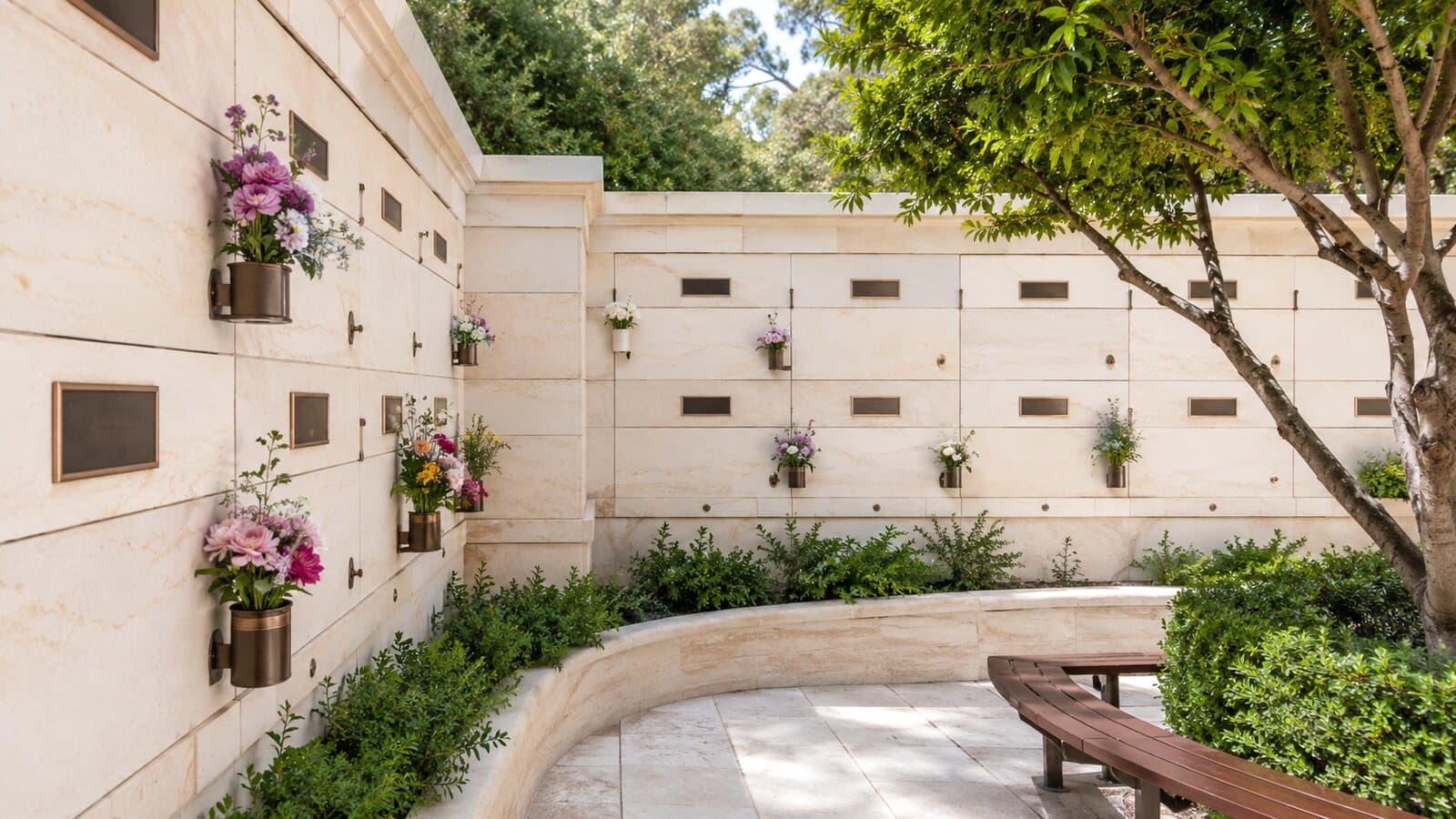
What is direct cremation in Australia?
Direct cremation is a cremation without a funeral service. No ceremony, no chapel, usually no viewing, and family usually do not attend. The funeral director collects the deceased, handles the paperwork, arranges the cremation at a licensed crematorium, and returns the ashes to the family.
It is also called an unattended cremation. The two terms describe the same service.
Direct cremation is the lowest-cost funeral option in Australia. There is no official national cremation rate for Australia, because the ABS does not record method of disposal in death registrations. The best available state evidence comes from Cemeteries and Crematoria NSW, whose 2023-24 Activity Report recorded a 73% cremation rate in NSW, from 48,252 cremations against 18,232 burials, covering an estimated 99.9% of interment services. Direct cremation is one part of that, chosen by families who want to separate the logistics from the farewell.
Every price here is a base advertised package price unless labelled otherwise. Named-provider figures come from each provider's own published pricing and show the month we last checked them; they are indicative, change over time, and vary by branch. Median and percentile figures are computed from providers' own published direct cremation prices, one price per brand, as at 26 September 2026. This is general information, not advice. Always request an itemised quote before signing anything.
- South Australia$2,350 to $3,179
Median $2,498 across 12 brands, the smallest sample that qualifies for a median, so provisional
- Queensland$2,628 to $4,470
Median $3,260 across 80 brands
- Victoria$2,871 to $4,744
Median $3,775 across 74 brands
- Australia$2,890 to $4,650
Median $3,648 across 296 brands. From $990 at a charity (crematorium fee extra).
- New South Wales$2,993 to $4,650
Median $3,749 across 107 brands
- Western Australia$3,050 to $4,539
Median $3,800 across 29 brands
Bar length compares the middle of each price range with the others. Figures are advertised prices and vary by provider and circumstance.
What a direct cremation includes
A standard direct cremation package includes:
- Collection of the deceased from the place of death (business hours, within a standard radius of 50km to 100km)
- Mortuary care (preparation and holding)
- A basic coffin (cardboard or MDF)
- Cremation at a licensed crematorium
- All paperwork: death registration, permits, medical certificate handling
- Return of ashes to the family in a basic container
What a direct cremation excludes
Direct cremation excludes everything related to a ceremony:
- Any form of service or ceremony
- Chapel or venue hire
- Viewing or visitation
- Celebrant or clergy
- Hearse (no service means no procession)
- Flowers, music, or order of service booklets
- Mourning cars
- Livestreaming
Families who want a farewell can hold a separate memorial at a time and place of their choosing.
What it costs
For the same physical service, published prices run from $990 at a charity (crematorium fee extra) to $8,782 at a premium corporate branch. Across the 296 brands that publish a price, the median is $3,648 and the middle half sit between $2,890 and $4,650, computed 26 September 2026. Named providers split across the range like this:
| Provider | Price | Tier | Checked |
|---|---|---|---|
| Bereavement Assistance (VIC, charitable) | from $990 (crematorium fee extra) | Charitable | September 2026 |
| Value Cremations | $1,399 (QLD), $1,699 (SA), $1,899 (NSW), $1,899 (VIC) | Budget | September 2026 |
| Light Cremations (Sydney) | $1,769 | Budget | September 2026 |
| Tony Hollands Funerals (QLD) | from $1,980 | Budget | September 2026 |
| Fixed Price Cremations (NSW/VIC) | $1,995 | Budget | September 2026 |
| Willed | $2,299 (QLD) to $2,699 (Canberra) | Budget | September 2026 |
| Salvos Funerals (not-for-profit, by location) | $2,348 (south east Queensland) to $3,725 (Perth); Sydney $2,975 | Budget | September 2026 |
| Soncini Funerals (Sydney) | $2,528 | Budget | September 2026 |
| Northern Beaches Funerals (Sydney) | from $2,848 | Mid-range | October 2026 |
| Bare Cremation | $2,899 (Adelaide) to $3,999 (Perth) | Budget | September 2026 |
| Greenfields Funerals (Perth) | from $4,260 | Mid-range | September 2026 |
| McCartney Family Funerals (QLD) | $4,395 (no service, no attendance) | Mid-range | September 2026 |
| White Lady Funerals (Pennant Hills, NSW) | from $8,782 | Premium corporate | September 2026 |
Swipe the table sideways to see every column.
The charity's price is for families in hardship and leaves out the crematorium fee. Against the lowest price outside charity pricing, $1,290 from Dignified Cremations (QLD), the most expensive is still several times higher for the same logistics.
Where the price difference sits
The cremation itself is charged by the crematorium, not the funeral director, and every provider pays broadly the same amount at a given crematorium. Published crematorium fees for a standard adult cremation range from $510 at Centennial Park in Adelaide to $1,838 at Thorak Regional Cemetery in Darwin, with Macquarie Park in Sydney at $650, Springvale Botanical in Melbourne at $1,210 and the Metropolitan Cemeteries Board in Perth at $1,422. All are GST inclusive and effective 1 July 2026.
Most of the difference between a $1,995 direct cremation and an $8,782 one sits in the professional service fee.
Here is roughly how White Lady's Cremation Only price at Pennant Hills (NSW) breaks down. The figures come from White Lady's price disclosure for that branch, dated 6 July 2026 and checked September 2026, on the basis of an adult cremation at Northern Suburbs Memorial Gardens, Monday to Friday. The split below is calculated from it.
| Line item | Cost | Share of total |
|---|---|---|
| Professional service fee (listed as No Service No Attendance) | $5,210 | about 59% |
| Everything else combined (transfer, mortuary care, coffin, cremation fee, certificates) | the balance | about 41% |
| Total | from $8,782 | 100% |
At a budget provider, the whole package can cost less than that professional fee on its own: Fixed Price Cremations lists $1,995 with the coffin and cremation included. The transfer, mortuary care, coffin, and cremation fee are broadly similar across all providers, because those are real costs with real inputs. The professional fee is where the prices differ most, which is why it pays to compare a few itemised quotes.
The memorial-after-cremation model
Many families who choose direct cremation hold a separate memorial days, weeks, or months later. This two-step approach separates the time-pressured logistics (which must happen within days of the death) from the farewell (which can happen whenever the family is ready).
Why families choose this approach:
In the first days, relatives may be spread across the country and decisions come fast. Direct cremation deals with the logistics now, without forcing the family to plan a service under pressure. The memorial happens later, when everyone can attend, when the family has had time to think about what the person would have wanted.
What a memorial costs:
A memorial held at home costs nothing beyond food and drink. A memorial at a park, a community hall, or a pub costs the venue hire and whatever the family chooses to spend. Some families hold the memorial at a beach and scatter the ashes. Some plant a tree.
Memorial-only packages from funeral directors vary widely with what they include. Some modern providers (Bare, Tomorrow Funerals) bundle the direct cremation and the later memorial into a single package. Traditional directors quote the memorial coordination separately.
What the two steps cost together depends mostly on the memorial you choose. If you are comparing this with a single cremation-with-service, ask the funeral director to itemise both so you can see the difference on paper.
The coffin question
For a direct cremation, the family usually do not see the coffin. There is no service, and usually no viewing or mourners. The coffin is used solely to transport and cremate the deceased.
A cardboard or MDF coffin does the same job as a timber coffin in this context. There is no legal requirement for an expensive coffin. Cardboard coffins are among the lowest-cost options: The Last Hurrah in Melbourne lists one at $300 plus delivery if required (checked September 2026), and Daisybox gives a recommended retail price of up to $395 for a plain casket, with a custom-printed design at around $1,395 plus artwork (checked September 2026). Many funeral directors supply them only inside a package rather than as a separate item.
In its 2019 funerals investigation, consumer group CHOICE reported that the coffin is "the product with the greatest markup, according to members of the industry", and that "industry insiders say funeral businesses routinely sell coffins for anything between two and ten times what they pay a wholesaler". For a direct cremation, the cheapest option the provider stocks does the job.
If a provider does not offer a basic coffin option or steers you towards an upgrade, consider getting a second quote.
After-hours transfers
Most deaths occur outside business hours. Direct cremation packages typically include transfer during business hours only.
After-hours and weekend charges vary widely between providers. Some charge nothing extra for an after-hours transfer, others several hundred dollars, and weekend or public holiday service surcharges are billed separately again. Ask for both to be itemised before you agree to anything, because this is one of the more common unexpected charges on a direct cremation invoice.
What happens to the ashes
After cremation, the crematorium returns the ashes (cremated remains) to the family or the funeral director, usually within a week or two; ask your funeral director for the expected date. The ashes come in a basic container.
Your options:
Keep them at home. No legal restriction on keeping ashes at home in any Australian state.
Scatter them. Permitted in most locations with landowner or local council permission.
Inter them. A columbarium niche or memorial garden placement at a cemetery. Costs vary by cemetery.
Divide them. There is no legal restriction on dividing ashes among family members.
You do not need to buy an urn from the funeral director. Funeral directors sell urns across a wide price range, but any suitable container works. Urns can be purchased independently online for less.
Who offers the most transparent pricing
Not all providers are equally upfront about what direct cremation costs. Based on our review of publicly listed pricing (September 2026):
Some providers publish full itemised pricing online. At the time of our review, this included Bare Cremation, Salvos Funerals, Greenfields Funerals, Lovell Meizer Funerals, Soncini Funerals, and Willed.
Large groups often publish their prices as branch price disclosures rather than on a main price page. White Lady Funerals, for example, publishes itemised disclosures for its branches in NSW, Queensland, the ACT and SA.
For some providers, we have found little or no published pricing. In South Australia, Tasmania, the ACT and the Northern Territory, where there is no rule requiring funeral directors to publish their prices, not publishing is legal, and it makes comparison harder for families working to a deadline.
Based on our own review of state and territory rules, four jurisdictions require funeral directors to publish their prices: New South Wales under the funeral goods and services information standard in the Fair Trading Regulation 2019, Queensland under the Fair Trading (Funeral Pricing) Regulation 2022 since 1 July 2022, Western Australia under the Fair Trading (Funeral Pricing Code of Practice) Regulations 2022 since 1 May 2023, and Victoria under the amended Funerals Act 2006 since 1 August 2025. South Australia, Tasmania, the ACT and the Northern Territory do not. This area keeps changing, so we review it regularly and update these guides as new rules take effect.
Frequently asked questions
What is a direct cremation?
How much does a direct cremation cost?
What is included?
Can I hold a memorial afterwards?
Why is there such a huge price range?
Do I need an expensive coffin?
Comparing direct cremation on price
Ask up to three funeral directors at once
Prices vary a lot between directors, so ask for itemised quotes in one go.
- Free
- You choose who
- No obligation
Works for planning ahead too. How we make money
Cremation costs by city
- Sydney: $3,498, median, 52 providers
- Melbourne: $3,447, median, 48 providers
- Brisbane: $2,750, median, 29 providers
- Adelaide: $2,498, median, 12 providers
- Perth: $3,500, median, 23 providers
- Gold Coast: $2,999, median, 17 providers
- Newcastle: $3,750, median, 15 providers
- Sunshine Coast: $1,399 to $6,878, full range, 8 providers
By state: Western Australia, Victoria, New South Wales, Queensland, South Australia, Tasmania, Australian Capital Territory, Northern Territory. Or compare every state and city.
This guide is general information to help Australian families, editorially reviewed by the Funerals Direct team from publicly available sources. It is not legal or financial advice. Every figure here is a working guide rather than a quote, because funeral prices change by provider, suburb, cemetery and crematorium. Before you sign anything, ask for an itemised written quote that separates the funeral director's professional service fee from third-party costs like the crematorium, cemetery, celebrant, flowers, notices and death certificate fees, and ask which of those items are legally required and which are optional. For prepaid funerals, bonds, or insurance, consider speaking with an independent financial adviser or a free financial counsellor on 1800 007 007.
Ready to find a funeral director?
Compare directors who list the right experience, read reviews from other families, and request a quote. Always free for families.
Compare funeral directorsWas this guide helpful?